How to Choose the Right Development Partner for Your AI-Powered SaaS MVP
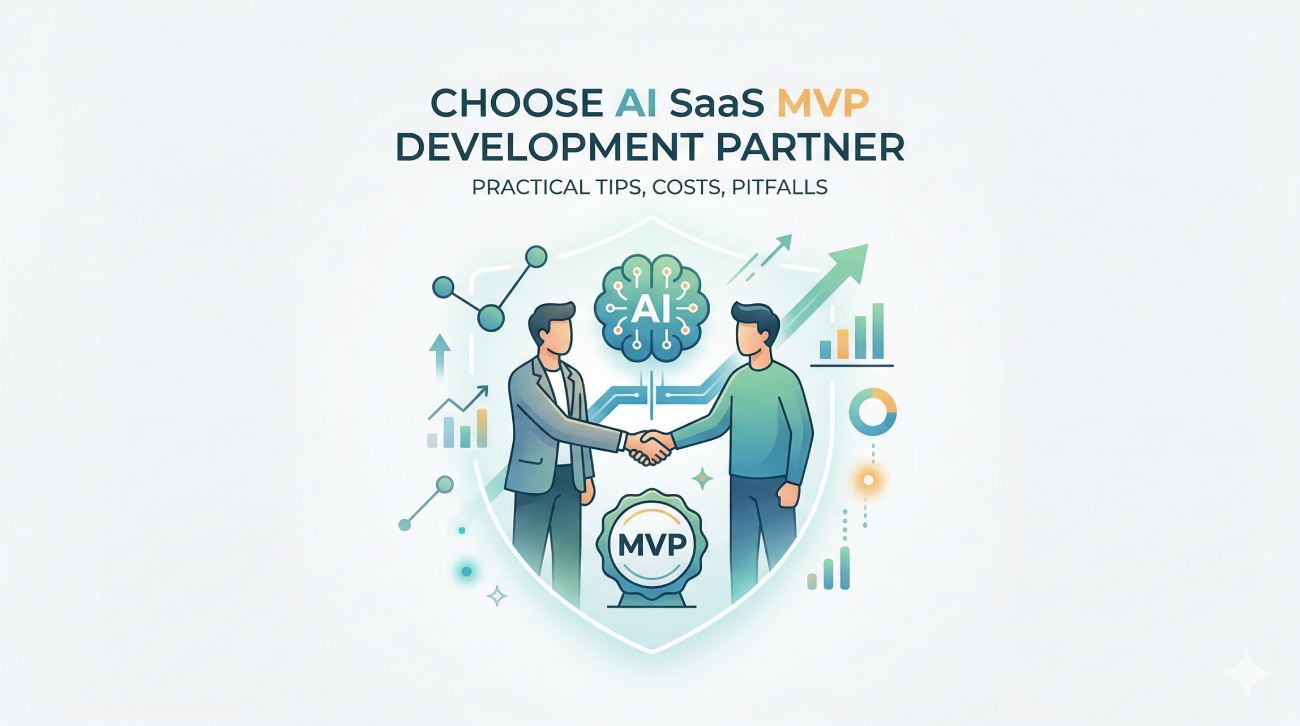
Choosing the right team can make or break your product. If you're figuring out how to choose a development agency for AI SaaS MVP, you're likely balancing speed, cost, and technical uncertainty. Founders often rush this decision—only to end up with missed deadlines, bloated budgets, or an MVP that can't scale.
This guide is for startup founders, business owners, and decision-makers who want a reliable, scalable AI SaaS product without wasting months or money. We'll walk through exactly what to look for, what to avoid, and how to evaluate agencies in a practical, no-nonsense way.
Why Your Development Partner Matters More for AI SaaS
Building an AI-powered SaaS MVP is not the same as building a standard web app. You're dealing with:
- Uncertain model behavior and outputs
- Rapidly evolving tools and frameworks
- Integration with APIs like OpenAI, Anthropic, or custom models
- Scalability challenges from day one
A generic dev shop might deliver something that works—but not something that survives real users. The right partner understands both product thinking and AI-specific constraints.
How to Choose a Development Agency for AI SaaS MVP
1. Look for AI Product Experience, Not Just AI Buzzwords
Many agencies claim AI expertise because they've integrated a chatbot once. That's not enough.
What you actually want:
- Experience building AI-driven SaaS products end-to-end
- Understanding of prompt engineering, model limitations, and evaluation
- Ability to design fallback systems when AI fails
Ask for real case studies. If they can't show how they handled edge cases or model errors, move on.
2. Evaluate Their MVP Thinking
A strong agency will challenge your idea—not blindly build it.
They should help you:
- Strip your idea down to core value
- Avoid overbuilding features
- Launch fast with meaningful validation
If their proposal includes 6+ months of development for an MVP, that's a red flag.
3. Check Their Technical Stack Alignment
Your AI SaaS MVP will likely involve:
- Frontend (React, Next.js)
- Backend (Node.js, Python)
- AI integration (OpenAI, vector databases, LangChain)
- Cloud infrastructure (AWS, GCP, Vercel)
The agency should clearly explain why they chose a stack—not just default to what they always use.
If your product includes a web interface, working with a web development company that understands performance and scalability is critical.
4. Assess Communication and Ownership
This is where most projects fail.
You need a partner who:
- Communicates proactively
- Flags risks early
- Thinks in terms of business outcomes—not just tasks
If they only respond when asked or avoid difficult conversations, expect problems later.
5. Review Their Approach to AI Uncertainty
AI outputs are not deterministic. Good agencies plan for that.
Ask how they handle:
- Inconsistent model responses
- Prompt optimization
- Latency and cost trade-offs
- Fallback logic when AI fails
If they treat AI like a simple API call, they're not experienced enough.
Cost Expectations for AI SaaS MVP Development
Let's be direct—AI SaaS MVPs are not cheap, but they don't have to be overpriced either.
Typical ranges:
- Basic MVP: $15,000 – $30,000
- Mid-level MVP with AI workflows: $30,000 – $70,000
- Advanced MVP with custom pipelines: $70,000+
What impacts cost:
- Complexity of AI features
- Number of integrations
- UI/UX requirements
- Scalability needs
Be cautious of agencies quoting extremely low prices—they usually cut corners on architecture or AI quality.
Red Flags to Avoid
Overpromising AI Capabilities
If an agency guarantees "perfect AI accuracy," that's unrealistic. AI always has edge cases.
No Clear Development Process
You should see a structured approach: discovery → prototyping → MVP → iteration.
Lack of Post-Launch Support
Your MVP is just the beginning. Without iteration, it will fail.
One-Size-Fits-All Solutions
AI SaaS products need tailored architecture. Templates won't cut it.
What a Strong Agency Process Looks Like
A reliable development partner typically follows this flow:
- <strong>Discovery:</strong> Define problem, users, and core value
- <strong>Technical planning:</strong> Choose stack, AI tools, architecture
- <strong>Rapid prototyping:</strong> Validate assumptions quickly
- <strong>MVP development:</strong> Build core features only
- <strong>Testing and iteration:</strong> Improve based on real usage
This process reduces risk and ensures you're building something users actually want.
Don't Overlook Platform Strategy
Your MVP might start as a web app, but what happens next?
If mobile is part of your roadmap, working with a mobile app development company early can save you from rebuilding later.
Planning for cross-platform scalability from day one avoids expensive rewrites.
How to Compare Agencies Effectively
Instead of guessing, evaluate agencies using these criteria:
- Relevant AI SaaS experience
- Clarity of communication
- Realistic timelines and costs
- Problem-solving approach
- Post-launch support
Shortlist 2–3 agencies and ask them the same questions. Their answers will quickly reveal who actually understands your product.
Mid-Project Reality Check
If you're already in discussions with developers and things feel unclear, that's a signal to pause and reassess. A strong AI app development company will bring clarity, not confusion—especially when defining scope, costs, and timelines.
Getting a second opinion before committing can save months of rework.
Common Mistakes Founders Make
Choosing Based on Price Alone
Cheap builds often lead to expensive fixes.
Skipping Technical Validation
Just because something sounds good doesn't mean it's feasible.
Overloading the MVP
More features = slower launch = delayed feedback.
Ignoring AI Costs
API usage, inference costs, and scaling can add up quickly.
Tools and Technologies Good Agencies Use
While tools evolve quickly, strong agencies stay updated with:
- LLM APIs (OpenAI, Anthropic)
- Vector databases (Pinecone, Weaviate)
- Frameworks (LangChain, LlamaIndex)
- Cloud platforms (AWS, GCP, Vercel)
More importantly, they know when not to use them.
Final Thoughts: Choose a Partner, Not Just a Vendor
The right development agency won't just build your MVP—they'll help shape your product, avoid costly mistakes, and accelerate your path to market.
If you're serious about launching an AI-powered SaaS product, don't rush this decision. Take the time to evaluate, question, and validate your options.
Ready to Build Your AI SaaS MVP?
If you want a development partner that combines product thinking, AI expertise, and fast execution, Appycodes can help.
Contact Appycodes today to discuss your idea, get a realistic roadmap, and start building an MVP that actually works—and scales.