
appycodes.

Anyone can describe programmatic SEO. Almost no agency has shipped one at scale.

One template engine. Hundreds of country pairs. Server-rendered per request with live data, not pre-built HTML. We architect the surface that turns a structured dataset into top-of-funnel traffic.

One engine, every pair

USA to USA

HK to USA

SG to USA

AU to USA

USA to UK

DE to USA

JP to US

IN to US

UK to IN

FR to US

CN to AU

SG to UK

NL to USA

USA to CA

CA to USA

AU to NZ

Every origin-destination pair: a separately indexable landing page with country-specific data.

What you get

Seven engagement shapes.

01

End-to-end engagements

Data architecture, template engine, SSR engine, sitemap, internal linking, monitoring. One owner across the chain.

02

Calculator-driven SEO surfaces

The Easyship pattern: pricing calculators, comparison tools, conversion calculators. The engine is the page; the page is the engine.

03

Location-driven SEO surfaces

City pairs, region-specific pricing, country-specific guidance. The shape that captures long-tail location queries.

04

Comparison-driven SEO surfaces

X-vs-Y, alternatives-to-X, done right, with unique data per page, not template fill.

05

Data sourcing

When to license a dataset, when to scrape public data, when to compute internally. We make the call honestly.

06

Performance engineering at scale

LCP under target across hundreds of generated pages. Cache key design that survives ISR invalidation.

07

Pruning

Identifying and removing variants that don't rank, so the high-quality ones don't get diluted. The unsexy ongoing work.

The engineering layers buyers underestimate

Seven layers that determine whether the surface ranks or gets pruned.

01

Real data source

Internal DB, scraped public data, partner API, or computed values. No data means no programmatic SEO.

02

Templating engine

Produces unique, fluent copy per variant. Not slot-filling. Country-specific phrasing, region-specific units.

03

Server-side rendering

Vue, Next.js or Nuxt SSR / SSG. Never client-rendered. Google won't index a blank shell.

04

URL strategy

Flat structure, canonical tags, internal linking between variants, sitemap generation.

05

Core Web Vitals at scale

Hundreds of pages means cumulative perf debt unless you architect for it. LCP under 2s targets per template.

06

Update workflow

When the underlying data changes, pages refresh without re-deploying. ISR / on-demand revalidation.

07

Eval

Search Console coverage by template, not individual URL. At this scale you can't audit one-by-one.

The programmatic SEO yield curve

Three programmatic SEO strategies. One actually compounds.

Measured in monthly organic clicks over the months after launch. AI sludge gets penalised and dies. Human-written thin content plateaus. Real-data programmatic compounds, but only after Google crawls and indexes at volume (about 90 to 180 days).

Dies

AI sludge

Thin, machine-spun pages with no real data behind them. They spike early on volume, then get penalised and collapse. Nothing compounds because there was never anything underneath.

Plateaus

Human-written thin

Hand-written but shallow. Modest, honest growth that flattens out fast. It survives the penalty filter but never captures the long tail, because each page says roughly the same thing.

Compounds

Real-data programmatic

Slow at first while Google crawls and indexes at volume (about 90 to 180 days), then compounds. Real data per page, real deltas per query. The only one of the three that keeps climbing.

Indexing at volume happens around day 90. Before that, the real-data curve looks flat. Judging it too early is how good surfaces get killed.

Evidence: Easyship

The calculator-as-SEO-engine pattern, at scale.

Easyship

Shipping SaaS · 550+ courier integrations

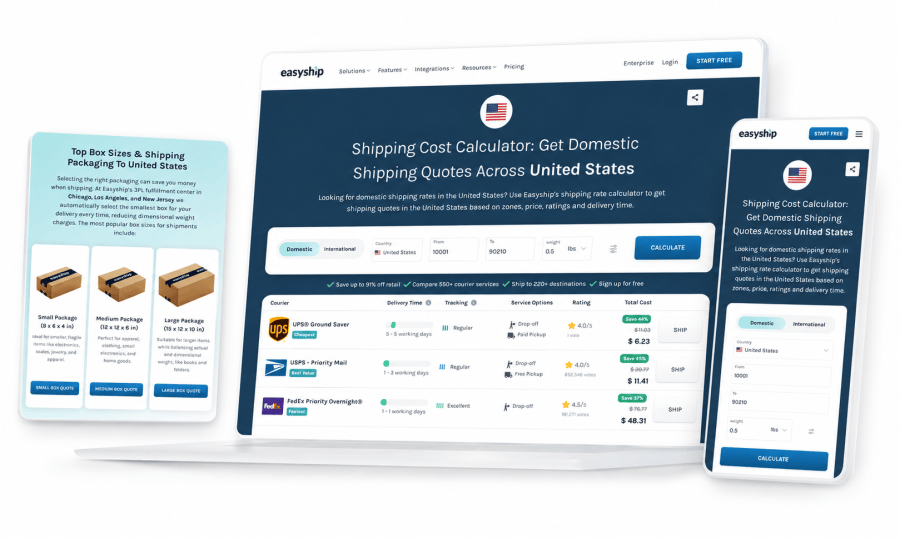
A $40M-valuation shipping SaaS with 550+ courier integrations. We built 100+ shipping rate calculators. From the outside they look like a simple form: origin, destination, weight, dimensions, product category, then a ranked list of couriers labelled Cheapest, Best Value, Fastest.

Under the hood, every origin-destination pair (USA to USA, HK to USA, SG to USA, AU to USA, hundreds more) is a separately indexable landing page, server-rendered with live rate data and country-specific FAQ content. The calculator is the same engine wearing different country pairs.

This captures every long-tail "shipping from X to Y" query, one of the highest-intent traffic sources possible for a shipping SaaS. Real data per page (UK customs differs from US customs), real "you save" deltas per user's parcel weight. Not slot-fill.

Read the Easyship case study. It pairs with technical SEO (schema and Core Web Vitals at scale), SaaS web app development, and SSR-heavy framework work for SEO surfaces.

Good fit if

You have a dataset worth indexing

  • SaaS and marketplaces with a structured dataset (rates, prices, locations, conversions, comparisons)
  • Teams who tried generating pages and got penalised, and want to do it correctly the second time
  • Companies with calculators or pricing tools that should double as top-of-funnel surfaces
  • Marketplaces whose long-tail demand isn't captured by their canonical category pages

Probably not a fit

We'll say so if the surface won't rank

  • Sites without a real dataset: programmatic SEO without data is content sludge
  • Operators looking for an AI content factory: that's not what this is
  • Teams without the patience for a 90 to 180 day indexing curve

Stack we ship on

Data, template, SSR, URL, monitoring.

Data
Postgres, DynamoDB, partner APIs, scraped and licensed datasets
Template engine
Per-template fluent copy, per-variant FAQ, structured-data injection
SSR / SSG
Next.js (App Router), Nuxt 3, ISR / on-demand revalidate
URL
Flat structure, canonical tags, sitemap.xml, internal-link graph
Monitoring
Search Console coverage by template, GA4, custom dashboards

Programmatic SEO

Bring the dataset and the audience. We'll architect the surface that captures them.

Contact