
technical SEO for SaaS

    Technical SEO for SaaS Startups

    We don't write your blog posts. We fix the technical reasons your pages aren't ranking — prerender, schema, Core Web Vitals, sitemap, internal linking, indexability. The engineering work most SEO agencies hand back to your dev team and hope they get to it.

    Technical SEO engineering for SaaS sites

    ■ Who this is for

    A good fit if your SEO ceiling is technical

    • SaaS founders whose pages don't get indexed despite shipping content
    • Product teams that built on a SPA and now realise Google can't see half of it
    • Companies with a content team writing well, but rankings flat or sliding
    • Founders who got an SEO audit back and have no idea who can actually fix it
    • Teams migrating to Next.js, Astro, or another framework who want SEO done right the first time

    ■ Probably not a fit

    We'll be honest if a different team is the right call

    • Pure content marketing engagements — we don't write your blog posts
    • Link building or PBN-style campaigns — not what we do
    • Local SEO or Google Business Profile optimisation
    • Sites with under 50 pages where the issue is simply not having content yet
    Appycodes

    Case Study · This site

    9 → 18

    Sitemap URLs (high-quality only)

    4

    Schemas per landing page

    Stack

    Vite · React Router · Helmet · Prerender SSG

    ■ Real work — recently

    We rebuilt this site for technical SEO. Here's what we did.

    appycodes.dev had the same problem most SaaS sites have — too many thin pages competing for the wrong terms, almost none indexed by Google, generic templated content with mismatched FAQs, no structured data in the prerendered HTML, and a sitemap full of URLs that Google had quietly ignored.

    The rebuild was straight engineering. We pruned the sitemap from 37 URLs down to 9 high-quality pages, then deliberately added new pages targeting winnable, intent-driven keywords — each with full JSON-LD schema (Service, BreadcrumbList, FAQPage, Article) baked into the prerendered HTML so crawlers see it on the first request, not after JavaScript executes.

    We fixed the prerender pipeline itself — the previous version was silently dropping every script tag that React Helmet emitted, which meant zero structured data was reaching Google despite being in the React tree. We added 301 redirects for the legacy URLs Google had indexed but no longer existed, rebuilt the internal linking from nav, footer, and the/services/ index, and shipped each new page at 2,000+ words with embedded case studies and opinionated technical content.

    This page is one of those new pages. The work it describes is the same work we ran on this site. You can inspect the source to verify.

    ■ How we approach technical SEO

    The six engineering decisions that move rankings

    These are the technical choices that actually change what Google sees and how it ranks your pages. We have strong opinions on each, formed from shipping SaaS sites that needed to compete in real SERPs.

    Rendering — SSG by default, SSR for dynamic, SPA for app

    Marketing pages should be static (SSG or prerender). Pages that depend on logged-in state should render server-side or remain SPA. The mistake most SaaS sites make is choosing one rendering strategy for the whole site. We split per route. Crawlers should see complete HTML on first byte for everything they need to rank.

    Structured data — JSON-LD in the prerendered HTML

    Service, Product, Article, FAQPage, BreadcrumbList, Organization, Person — chosen per page type, not blanket-applied. We verify with Google's Rich Results Test before considering it shipped. Critically, the schema must land in the static HTML, not be inserted later by JavaScript — we have seen many sites where the schema exists but Google never sees it.

    Core Web Vitals — LCP, CLS, INP

    We profile real user metrics from CrUX or your own RUM data, not synthetic Lighthouse scores. The fixes are usually the same handful of patterns: defer or remove heavy third-party scripts, preconnect to font hosts, set explicit dimensions on images, lazy-load below the fold, swap heavy fonts, replace images with modern formats. Lighthouse 100 is not the goal — passing field data is.

    Indexability — robots, sitemap, canonicals, internal links

    A page is not indexed unless Google can crawl it, render it, and conclude it deserves to be indexed. We check robots.txt, sitemap freshness, canonical correctness, hreflang if international, and the internal link graph that signals page importance. Orphaned pages with no internal links almost never rank.

    Site architecture — flat depth, intentional clusters

    Two clicks from the homepage to any important page. Topic clusters where pillar pages link to detail pages and vice versa. Avoid deep folder nesting unless the URL hierarchy adds genuine value. We restructure URL trees when needed but always with 301s and the patience to wait for Google to recrawl.

    Monitoring — Search Console, log files, RUM

    After the work ships, we set up Search Console properly, run weekly checks on indexation and Core Web Vitals, and monitor server log files to see what Googlebot actually crawls vs ignores. Without monitoring, you don't know whether the work paid off — you're guessing from rank trackers, which lag and lie.

    ■ Real work

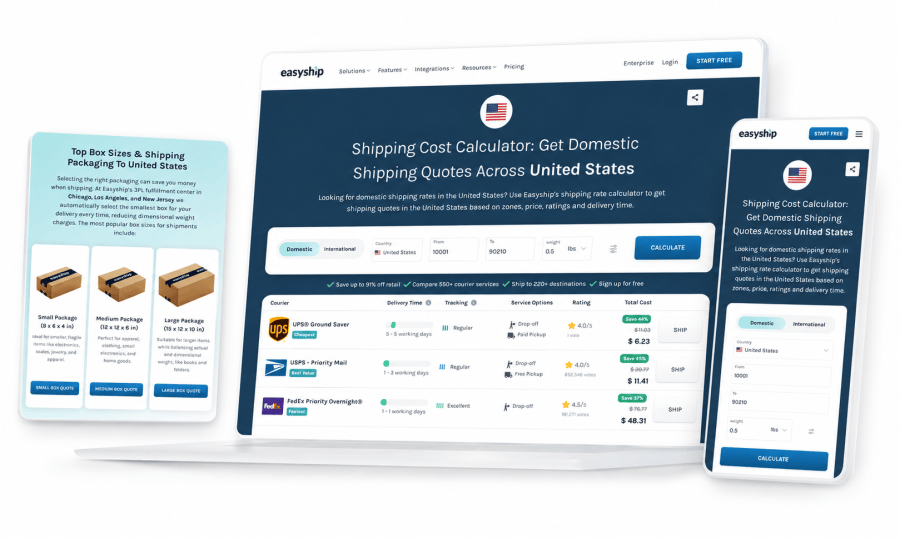
    Why Easyship's calculator pages are a technical SEO problem

    Easyship is a global shipping platform now valued over $40M. More than 100 calculator engines power their site — quote tools that compare carriers, rules, surcharges, and customs across 200+ countries. Each one is a high-intent commercial query (think "USPS to UK shipping calculator") that should rank.

    The technical SEO challenge with calculator pages is that they're fundamentally interactive — users pick options and the result computes client-side. That makes them dangerous for crawlers if rendered the wrong way. Google sees an empty form; the page looks thin and gets demoted or skipped entirely.

    The right pattern is to ship a meaningful default state in the static HTML — populated with realistic values, real explanatory copy, an example calculation, and proper schema for the service being offered. The interactive calculator layers on top once JavaScript runs. Crawlers get a full page; users get a working tool. That principle is the difference between calculator pages that rank and calculator pages that don't.

    Easyship logo

    Case Study · Shipping SaaS

    $40M+

    Company valuation

    100+

    Calculator pages

    Stack

    React · TypeScript · Node.js · Vue.js

    ■ How we work

    From audit to indexation, in six steps

    01

    Technical audit

    Crawlability, indexability, rendering, structured data, Core Web Vitals, site architecture, on-page signals. You get a written audit with a prioritised fix list — not a generic PDF, not a sales document.

    02

    Quick wins first

    Robots, sitemap, canonical, broken redirects, indexation issues, missing meta — the changes that ship in the first sprint and start moving Search Console signals immediately. We do these before touching anything that takes longer.

    03

    Rendering and prerender

    Move marketing pages to SSG or prerender. Verify the rendered HTML matches what users see. Check that JavaScript-injected content (titles, schema, internal links) actually lands in the static output. This is where most SaaS SEO work breaks silently.

    04

    Structured data

    Add JSON-LD per page type. Verify with Google's Rich Results Test. Check that the schema is in the prerendered HTML, not inserted later. Add Organization, BreadcrumbList, and Article or Service schemas across the site as appropriate.

    05

    Core Web Vitals

    Profile real user metrics. Fix LCP (defer scripts, preconnect fonts, optimise hero images), CLS (set image dimensions, reserve space), INP (split long tasks, defer non-critical JS). Re-measure with field data, not Lighthouse.

    06

    Internal linking and monitoring

    Rebuild navigation, footer, and contextual internal links to signal page importance properly. Set up Search Console correctly, configure indexation monitoring, and check server logs for Googlebot crawl patterns. Hand over a written runbook of what to watch and when to act.

    ■ Honest comparison

    Appycodes vs your other options

     SEO agencySolo SEO consultantIn-house devAppycodes
    Technical engineering depthLimitedLimitedHighHigh
    Ships fixes in productionHands off to your dev teamHands off to your dev teamYesYes
    Ranking strategy and intentYesYesRarelyYes
    Schema, prerender, CWV done rightSometimesSometimesIf they prioritise itYes
    Time to ship first fixes4-8 weeks4-6 weeksWhenever it gets prioritised1-2 weeks
    Owns code that landsNoNoYesYes
    Writes contentOftenSometimesNoNo

    None of these is universally right. A traditional SEO agency is the best call when your bottleneck is strategy, not engineering. We are the best call when an audit has already told you what's wrong and the problem is that nobody on your team has the time, context, or engineering depth to actually ship the fixes.

    ■ Questions we get

    Real questions from real founders

    If yours is not here, ask us directly.

    About the author

    Ritesh — Founder, Appycodes

    Ritesh leads engineering at Appycodes and has spent the last decade shipping SaaS products for funded startups across the UK, US, India and Australia. His focus is on production engineering — including the technical SEO work that quietly determines whether a SaaS product's content compounds or stalls.

    Taking the first step is the hardest. We make everything after that simple.

    Let's talk today