■ shopify development services
Custom Shopify themes built mobile-first. Migrations from WooCommerce, Magento, OpenCart, and custom platforms. Shopify apps for ERP, CRM, and marketplace integrations. Supplier-feed automation for catalogues in the tens of thousands of SKUs. Real stores in production today.

■ Who this is for
■ Probably not a fit
Case Study · US Trade & Consumer · Outdoor Power Equipment
In-stock SKUs
Parts catalogue access
Stack
Shopify Plus · Liquid · Custom Apps · Carrier-Calculated Shipping
■ Real work · Featured engagement
The OEM Parts Store is a US distributor of outdoor power-equipment and trailer parts — Briggs & Stratton, Kohler, Tecumseh, MTD, Stens, Rotary, Dexter, and many other brands — selling to landscapers, small-engine repair shops, trailer repair centres, and prosumer DIY buyers. The merchant carries 70,000+ SKUs in active stock and offers customers access to more than a million OEM and replacement parts through their distributor network. The legacy storefront was on a custom platform; we replatformed the catalogue onto Shopify on the store. subdomain.
The hardest engineering problem was not the theme. It was the data pipeline. Every supplier sends pricing and inventory differently — some by FTP CSV, some via REST API, some via emailed spreadsheets on a fixed weekly cadence. We wrote a scheduled ingestion service that normalises each feed into a single internal product representation, reconciles it against the Shopify catalogue using SKU and metafield keys, and then pushes deltas into Shopify — new product creation, price updates, stock-level changes, and discontinuation flagging — through the GraphQL Admin API with proper rate-limit and bulk-mutation handling. The job runs without breaking the storefront, even during the peak feed window.
On top of that we wired in carrier-calculated shipping rates as a Shopify Custom Carrier Service so buyers see real-time freight pricing on heavy and oversized items at checkout, and a same-day shipping cutoff badge that flips automatically based on order time. Buying 10,000 catalogue items on Shopify is one experience. Buying 70,000 with live supplier sync, fitment metadata, brand-level taxonomies, and trade-aware shipping is a different category of build — and the one this client needed.
Case Study · Germany · Pet Food & Animal Feed
Active SKUs
Multilingual storefront
Stack
Shopify · Liquid · Custom App · Marketplace Sync
■ Real work
Tierfutter Pro (operated by JJ's Food & Feed Trade GmbH out of Herzlake, Germany) is a specialist online retailer of premium pet food and animal feed for dogs, small animals, and poultry. The catalogue runs to over 3,500 active SKUs spanning dry and wet feed, supplements, training food, and accessories — a deep enough taxonomy that faceted filtering by species, food type, and dietary attribute is the difference between a customer finding the right product and bouncing.
We built the storefront as a custom Shopify theme designed mobile-first, with German as the default language and a full English mirror at the/en/ sub-path so the brand can serve EU buyers outside Germany without spinning up a second store. Localisation isn't only about translation — we wired in the German-market essentials too, including Kauf auf Rechnung (invoice payment) at checkout, the €49 free-shipping threshold logic, and tax / VAT handling for intra-EU sales.
Because the brand also sells through Amazon DE and an eBay DE shop, inventory and pricing sit in a single source of truth that pushes out to Shopify and the marketplaces in lockstep. We built the sync layer so a stock change made by the warehouse team propagates everywhere inside a few minutes — not at the end of the day, when the wrong product has already oversold.
■ How we approach Shopify
We have strong opinions about how Shopify should be built when the store is doing serious revenue. Here's what we reach for by default, and the reasoning behind each choice. We deviate when there's a real reason — not because something is trending in the Shopify Partner ecosystem.
We build new themes on Online Store 2.0 with reusable sections and JSON templates so the marketing team can compose any page from the theme editor without a developer in the loop. We avoid heavy page-builder apps that re-render half the storefront in JavaScript — they're slow, expensive, and a nightmare to maintain three years in.
60–80% of Shopify traffic is mobile. We design every PDP and collection page for 360px before we look at the desktop layout. Lazy-loaded images using Shopify's responsive image pipeline, font subsetting, deferred third-party scripts, and a hard cap on app-injected JS. LCP, CLS, and INP are budgeted, not hoped for.
WooCommerce, Magento, OpenCart, BigCommerce, and custom platforms — we've migrated all of them. The work is more than a CSV. We map customers (with password-reset flows because hashes don't carry across), historic orders, product variants, metafields, redirects from old URLs to preserve SEO, tax zones, payment provider switching, and a rehearsed cut-over plan. We use Shopify APIs, Matrixify, and custom scripts depending on what the source platform actually exposes.
When the storefront needs logic that doesn't belong in Liquid — ERP sync, CRM data exchange, billing software integration, custom merchant dashboards, marketplace exports — we build a private or public Shopify app on App Bridge and Polaris. OAuth, GraphQL Admin API, webhooks, queue-backed background jobs, and rate-limit-aware retries. Apps that survive your first Black Friday.
For stores in the tens of thousands of SKUs, the killer feature is not the theme — it's the catalogue automation. We write scheduled ingestion services that pull supplier price and stock files (CSV, FTP, API), normalise them, and push deltas into Shopify with proper rate-limit and bulk-mutation handling. We've done this for catalogues up to 70,000+ active SKUs.
Built-in Shopify shipping is fine for most DTC. When the store has freight, oversize items, multi-warehouse split shipments, or trade-customer pricing, we integrate third-party shipping APIs as a Shopify Custom Carrier Service so checkout returns real-time rates. This requires Shopify Advanced or Shopify Plus — we'll tell you up front whether the upgrade is worth it.
Custom collection filters via Shopify Search & Discovery and metafields. Branching product-finder quizzes. Photo-upload configurators on personalised products. Bundle / build-your-own kit builders. Complex pricing tools — quantity breaks, trade tiers, surcharges. We write these as Liquid sections and JS modules, not as bolt-on apps that bloat the page.
Headless Shopify with Hydrogen (Remix) or Next.js shines when the brand needs a faster front-end, a non-Shopify CMS in front of products, or a unified app/web experience. It costs you the live theme editor, native checkout customisations, and the ecosystem of standard apps. We go headless when the product genuinely benefits — not because it's the fashionable answer.
■ Real work
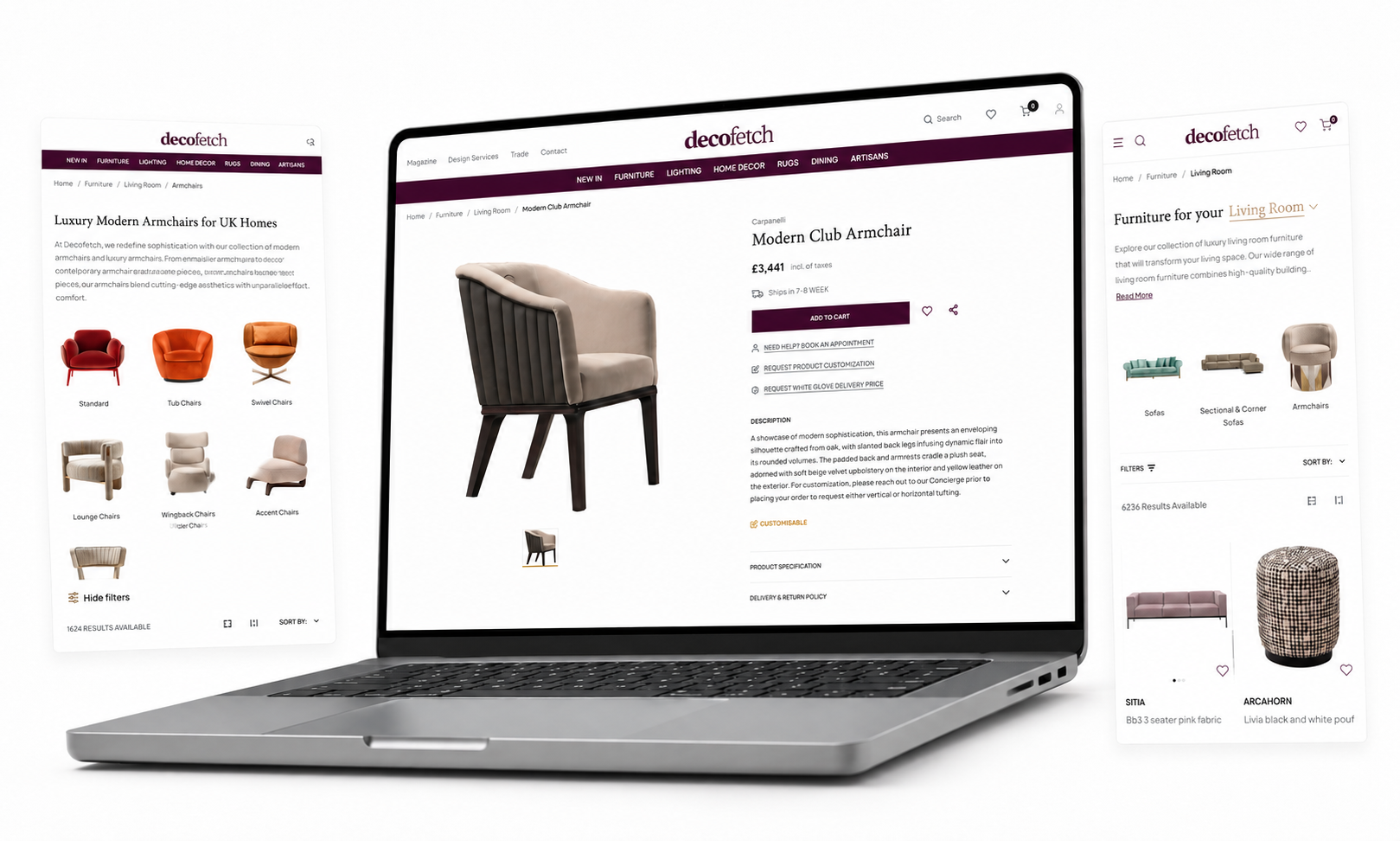
Shush London is one of the UK's longest-running preloved designer fashion retailers — almost four decades of authenticated luxury resale out of St John's Wood. The catalogue spans Chanel, Hermès, Louis Vuitton, Gucci, Prada, Dior, Burberry, Cartier, Rolex, Jimmy Choo, Christian Louboutin, Stella McCartney, Alexander McQueen and many more, across womenswear, accessories, fine jewellery, and watches. The hard part of selling preloved luxury on Shopify is that every item is a one-of-one — a single quantity, photographed individually, with its own condition and provenance notes.
We built the storefront as a custom Shopify theme designed for unique-SKU merchandising: collection grids that surface recently-listed pieces fast, tag-driven filtering that lets shoppers narrow by category, designer, size, and price band, and PDPs structured around authenticated condition messaging. Mobile first, with image performance treated as a feature — most resale buyers are scrolling on a phone before they ever sit at a desktop.
The store also runs a two-sided flow most Shopify themes don't support out of the box: a consignment / sell-with-us workflow that funnels potential consignors into an intake form, separate from the buyer journey. We built that into the same Shopify install rather than fragmenting the brand across two systems, so the marketing team has one place to manage the storefront and one place to manage seller leads.
Case Study · UK · Luxury Resale Fashion
Brand heritage
Unique-SKU catalogue
Stack
Shopify · Custom Liquid Theme · Tag-Driven Filtering
Case Study · India D2C · Sustainable Period Wear
Standard 100 certified
Curated kit-builder
Stack
Shopify · Custom Theme · Bundle Builder · Social Commerce
■ Real work
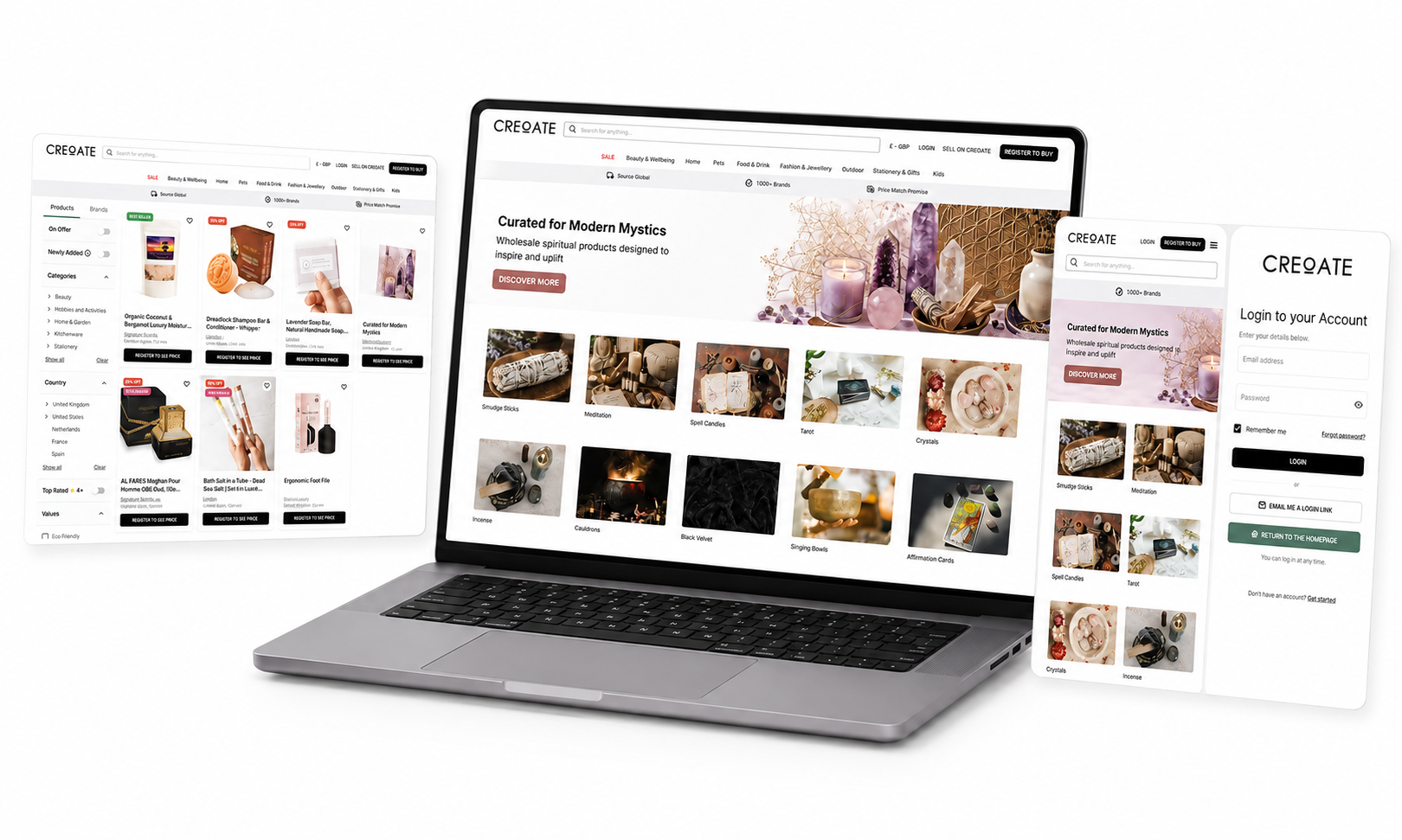
Woomflo is a Bangalore-based D2C menstrual underwear brand built around reusable, leak-proof, OEKO-TEX Standard 100 certified period wear. Designs and 100% of materials are sourced locally in India, and the brand is positioned for both the Indian market and international export to the sustainable-living audience. Selling a category that's both intimate and educational means the storefront has to do real work — not just display products, but explain silhouette differences (Bikini, Hipster, Shorty) and absorbency levels in pad and tampon equivalents.
We built the storefront as a custom mobile-first Shopify theme designed for education-led PDPs and curated bundle merchandising. The Essential Pack and Teen Pack land as their own product pages rather than upsell modals, because that's how the brand wants customers to discover them — as considered kits, not impulse buys. The Teen Pack runs as a separately-merchandised line for an age-segmented audience, with copy and imagery handled accordingly.
Beyond the storefront, we wired in the integrations a modern Indian D2C brand actually needs day to day — Instagram and Facebook social commerce so product tags work natively, plus marketplace presence on Brown Living for omnichannel discovery. Mobile-first wasn't a label we slapped on the proposal — it was the design constraint we built every PDP against.
■ Real work
Puzzle This is a personalised-puzzle e-commerce brand — customers upload their own image and the store turns it into a printed jigsaw puzzle shipped to their door. The interesting engineering on a store like this isn't the catalogue. It's the configurator on the product page, which has to take an arbitrary user photo, validate resolution against piece-count thresholds, render a live preview, and carry the asset all the way through checkout into fulfilment without losing the original file.
We built the configurator as a custom Liquid section with a JavaScript module on the PDP. The flow handles photo upload, crop and rotate, piece-count and size selection, optional gift packaging, and a real-time preview the buyer can confirm before adding to cart. Each line item carries a reference to the customer's uploaded asset so the production team can pull the print-ready file directly from the order — no chasing emails for original images.
Underneath the configurator, the store runs the merchandising features personalised-product brands actually need: branching product-finder logic for gifting use cases, complex pricing tools for size and piece-count combinations, and a fulfilment hand-off that keeps the production team in the loop without giving them Shopify admin access. The result is a storefront that looks like a consumer brand and operates like a custom-print operation.
Case Study · Personalised Photo Puzzles
PDP configurator
Preview rendering
Stack
Shopify · Liquid · Photo Upload Module · Print Fulfilment
■ How we work
One week. We map the catalogue, the merchandising model, the integrations the store actually has to support (ERP, marketplaces, shipping carriers, marketing tools), and the business goals behind the build. For migrations, we audit the source platform's data model. Output: a written architecture and a 90-day plan.
We choose the Shopify plan (Standard / Advanced / Plus), the theme strategy (custom Online Store 2.0 vs headless Hydrogen / Next.js), the app footprint, and the hosting story for any companion services. CI, version control, and a development store get set up before any production code lands.
Theme scaffolding, base sections, metafield model, navigation, and the Shopify admin set up the way the merchandising team will actually use it. Custom apps and supplier-feed services scaffolded with auth, queues, and logging. By the end of sprint zero, the merchant can log into a working development store.
Two-week sprints. Theme work, app work, and integrations shipped through CI. Every change reviewed. Scope changes get re-baselined at sprint boundaries, not mid-sprint. You see progress every Friday — and a working preview store you can poke at any time.
For migrations: a rehearsed dry-run on the development store, then the live cut-over with redirects, customer password-reset flows, payment provider switch, and a checklist that's been run through twice. Performance pass on Core Web Vitals, app audit, security headers, and a Black-Friday-grade load expectation.
We stay on full availability for the first month after launch. Real customers find real bugs. Then we move into the standard maintenance and feature retainer — supplier-feed scripts that need to absorb a new vendor format, theme changes around a campaign, and the occasional emergency that comes with running a real store.
■ Honest comparison
| Theme-only Partner | Shopify freelancer | In-house Shopify dev | Appycodes | |
|---|---|---|---|---|
| Custom Liquid theme development | Yes | Mixed | Yes | Yes |
| Migration to Shopify (Woo / Magento / Open / custom) | Rare | Sometimes | If they prioritise it | Yes |
| Shopify app development (private / public) | No | Rare | Sometimes | Yes |
| Catalogues 50K+ SKU with feed automation | No | No | Maybe | Yes |
| Carrier-calculated shipping on Plus / Advanced | Rare | Rare | Yes | Yes |
| Time to start | 1-3 weeks | 1-2 weeks | 8-16 weeks | 1-2 weeks |
| Continuity if someone leaves | Mixed | High risk | Yes | Built in |
None of these is universally right. A theme-only Partner is fine for standard DTC. A Shopify freelancer is fine for narrow theme tweaks. We tend to be the right call when the build is genuinely engineering work — migration, custom apps, complex catalogues, calculated shipping, or integrations Shopify alone doesn't cover.

About the author
Ritesh leads engineering at Appycodes and has spent the last decade shipping Shopify storefronts and apps for serious merchants across the UK, US, Germany, India and Australia — including The OEM Parts Store's 70,000-SKU catalogue, Tierfutter Pro's multilingual German storefront, Shush London's luxury resale catalogue, Woomflo's D2C launch, and Puzzle This's photo configurator. His focus is on production e-commerce engineering: the unglamorous decisions that keep a Shopify store fast, reliable, and easy to change years after launch.
■ Other services
Explore the rest of what we build.
MVP to production builds, multi-tenant, billing, AI features.
Learn moreiOS + Android in one codebase. Push, offline, OTA updates.
Learn morePrerender, schema, Core Web Vitals — engineering-led SEO.
Learn moreB2B marketplaces, membership sites, headless WordPress.
Learn morePost-launch stability, security, monthly improvements.
Learn moreTake an AI-built prototype to a production-ready product.
Learn moreConvert AI-built web prototypes into native mobile apps.
Learn moreSubmit, configure and optimise for App Store + Play Store.
Learn moreModernise legacy systems with zero-downtime migrations.
Learn moreEngineering capacity for agencies, under your brand.
Learn moreFrom idea to live product — design, build, launch, growth.
Learn moreCustom REST/GraphQL APIs and third-party integrations.
Learn moreMulti-tenant AI SaaS with subscriptions and admin dashboards.
Learn more