
■ react native app development
One React Native codebase. iOS and Android in lockstep. Push, offline, OTA updates, App Store and Play Store submission handled. Built by engineers who ship production B2B and B2C apps — not template apps.

■ Who this is for
■ Probably not a fit

Case Study · Native Mobile App
Parent company valuation
Native app shipped
Stack
React Native · TypeScript · Node.js
■ Real work
Khatabook is one of India's most-used SMB finance brands, valued at over $600M. As they expanded the product line beyond the flagship app, our team partnered with their core engineering on the native build of Bills & GST — a separate mobile app focused on GST-compliant invoicing and tax workflows for small businesses.
We did not work on the main Khatabook app. Bills & GST was a distinct product surface that needed its own engineering team and its own architectural decisions. We embedded with the Khatabook core team, contributed across the React Native build, the supporting Node services, and the GST-engine integrations that have to behave precisely under audit conditions.
Two engineering choices held up across the project: keeping the React Native bridge thin enough that screens were ready in under 200ms even on entry-level Android devices, and treating the network as the most likely thing to fail. SMB users in tier 2 and tier 3 cities open the app on patchy connections; an app that assumes a perfect connection loses them in the first week.
■ Stack we'd pick today
We are not stack agnostic. After a decade of shipping mobile apps, we have strong views on which platform earns its keep for which product. Here's what we reach for and why. We will tell you directly if your product is in the small minority that needs something else.
One codebase, two stores, deep React talent pool, and shared business logic with your web app. We use Expo's bare workflow when we want EAS for builds and OTA but full access to native modules. Hot reload and TypeScript across the boundary make sprint velocity meaningfully higher than native.
Flutter is a great option if you already have Dart on the team or if your design needs pixel-identical rendering across platforms. The talent pool is shallower than React Native and the integration story with React-based web is weaker — so we rarely default to it for B2B and B2C apps.
If the app needs heavy AR, deep system integration, performance-critical hardware access, or platform-specific UX patterns that users expect, native wins. We've shipped native when it was the right call. Most B2B and B2C apps are not in that category.
Zustand for most products — it's small, fast, and obvious. Redux Toolkit when the team already knows it and the data model is genuinely complex. React Query handles server state, caching, and the invalidation logic you would otherwise rebuild badly. We avoid bespoke state libraries.
AsyncStorage for tiny preferences. SQLite via WatermelonDB for anything resembling a real local dataset. We avoid syncing-by-magic libraries — the conflict logic always becomes a debugging tax later. Explicit sync that you can read and reason about ages much better.
EAS for builds, signing, and submission to both stores from a single config. CodePush or EAS Update for OTA updates of the JavaScript bundle. Native module changes still need a real store update — we are deliberate about which changes go which path.
■ Real work
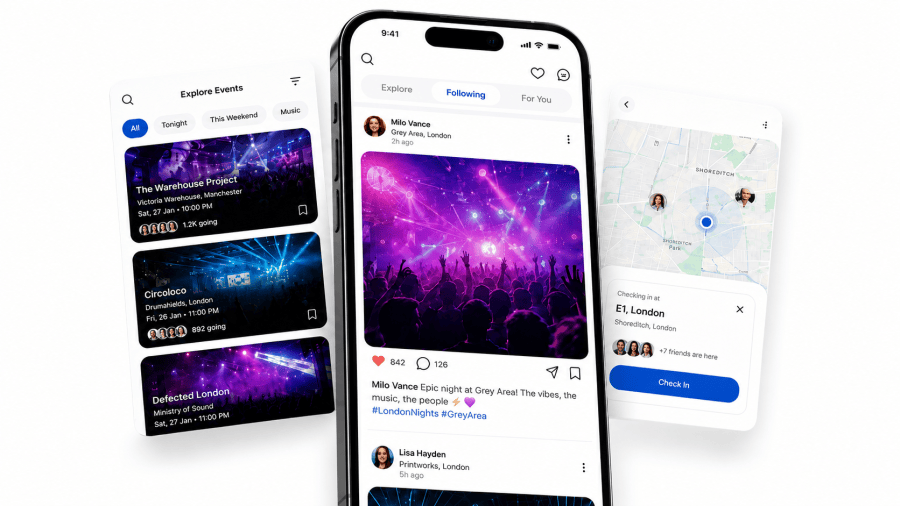
Bloc is a social and events platform with a mobile-first product surface — discovery, RSVPs, group messaging, and the real-time interactions that make a community app feel alive. The challenge was not any single feature; it was keeping the app responsive while real-time updates, social feeds, and notifications all competed for the main thread.
We shipped over 500,000 lines of code into the Bloc stack across React, React Native, and Node — including the messaging layer, the real-time presence system, and the feed ranking surfaces. Traffic on the platform grew 70% during our engagement, and the app held up because the architecture had been designed for it from the second sprint, not patched together later.
The single best decision was investing early in a tested, predictable network layer. Every API response shape was typed and validated; every retry, timeout, and offline fallback was written once and reused everywhere. When the team needed to add a new feature, it was almost never the network part that slowed them down.

Case Study · Social & Events
Lines of code shipped
Traffic growth
Stack
React · React Native · Node.js · MongoDB
■ How we work
One week. We map the product, the user journeys that matter on mobile, and the platform-specific behaviour you can't ignore (notifications, deep links, app store policy, biometrics). Output: a written architecture and a concrete plan for the first 90 days.
We choose the stack, design the navigation tree, define the offline and sync model, and confirm the OTA update strategy before writing production code. Decisions get documented so the next engineer to join is not guessing.
Auth, deep linking, the navigation shell, the design system primitives, CI builds for both platforms, and a deployable internal build. By the end of sprint zero you can install the app on a real device.
Two-week sprints. Internal builds shared via TestFlight and Firebase App Distribution after every sprint. Scope changes get re-baselined at sprint boundaries, not mid-sprint.
Performance pass on real low-end devices, offline scenarios tested deliberately, push notification flows verified end to end, store listing copy and screenshots prepared, privacy declarations filled in. We launch with monitoring and crash reporting already wired up.
We submit to both stores, handle reviewer back-and-forth, and stay on full availability for the first month after launch. Real users surface issues that no internal test catches. Then we move into the standard maintenance and feature retainer if you want us to keep going.
■ Honest comparison
| Freelancer | Local agency | In-house hire | Appycodes | |
|---|---|---|---|---|
| Senior RN engineers | Maybe | Mixed | Yes — once hired | Yes |
| Time to start | 1-2 weeks | 2-4 weeks | 8-16 weeks | 1-2 weeks |
| Both iOS and Android coverage | Often partial | Yes | Depends on hire | Yes |
| App store submission handled | Rarely | Yes | Yes | Yes |
| Continuity if someone leaves | High risk | Medium | Yes | Built in |
| Owns code and IP | Mixed | Yes | Yes | Yes — fully |
| Bug response after launch | When available | Business hours | Yes | Yes |
None of these options is universally right. A senior RN freelancer is fine for a focused two-week task. An in-house hire is the right move when you have time and certainty. We tend to be the right call when you need senior delivery quickly, with continuity, and someone who has actually been through a few app store reviews before.
About the author
Ritesh leads engineering at Appycodes and has spent the last decade shipping mobile and web products for funded startups across the UK, US, India and Australia — including Khatabook, Bloc, CREOATE, and others. His focus is on production engineering: the unglamorous decisions that make a mobile app feel fast on real devices and easy to change six months after launch.