
 By Ritesh Agarwal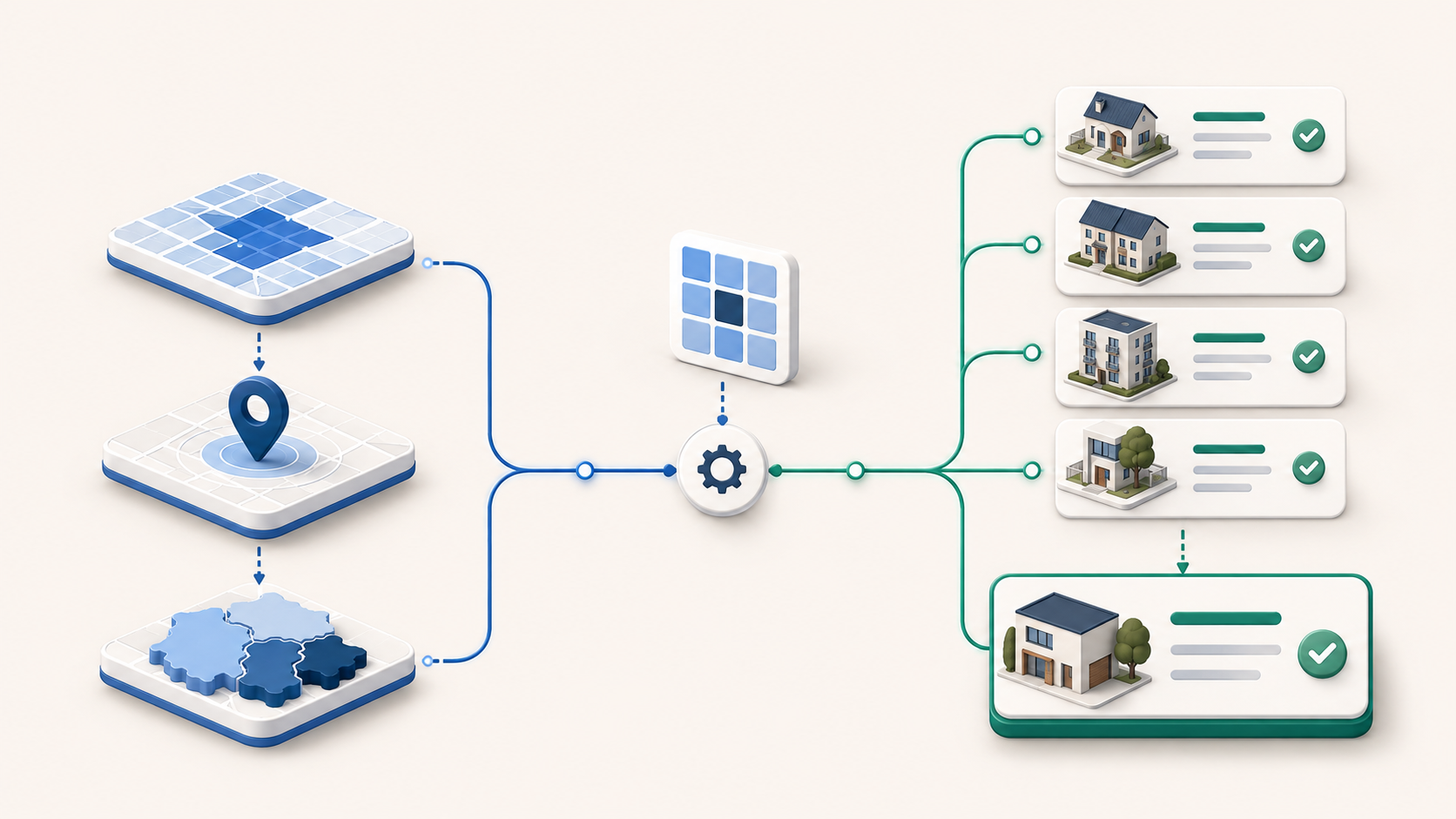
Direct answer
Use Postcodes.io when you need to validate a postcode, locate it, or attach region, constituency and local-authority data. Use Ideal Postcodes when a person must select a complete UK delivery address—flat, building, organisation, post town and postcode. For many service-area products, the right architecture is both: postcode geography for eligibility, then an address service only when a full premises record is actually required.
The names make these services sound interchangeable. They are not. The choice is a data-modelling decision with consequences for conversion, fulfilment and support. Asking “which postcode API is cheaper?” skips the more important question: does this step need a postcode record or an address record?
Postcodes.io and Ideal Postcodes return different kinds of record
Postcodes.io answers “where is this postcode?”
Postcodes.io describes itself as a free UK postcode lookup API and geocoder. Its open-source service exposes postcode lookup, autocomplete, bulk lookup, reverse geocoding, nearest-postcode search and terminated-postcode search. The underlying service publishes the ONS Postcode Directory, Ordnance Survey Open Names and Scottish Postcode Directory datasets. Postcodes.io API documentation Postcodes.io source and data overview
A result can include a normalised postcode, latitude and longitude, country, region, local authority, parliamentary constituency, statistical areas and their codes. That is excellent for territory checks, routing, analytics, public-data joins and answering “is this postcode in an area we serve?”
A postcode is not a premises
One postcode can cover several delivery points. Postcodes.io does not return the houses, flats or organisations at that postcode, so it cannot populate a complete shipping, installation or contract address. The coordinates are postcode-level, not proof of a property entrance or customer location.
The Office for National Statistics explains another subtle limitation: ONS postcode directories contain current and terminated postcodes, and postcode geography does not always follow administrative boundaries. ONSPD assigns a postcode according to the administrative area containing its geographical centre. ONS guidance on postcode directories and boundaries
Ideal Postcodes answers “which deliverable address did the user mean?”
Ideal Postcodes provides authenticated address search, postcode lookup and address cleansing. A postcode lookup returns the structured addresses at that postcode; its two-step Address Search finds candidates from partial text and resolves the selected candidate to a full record. The service identifies Royal Mail PAF as a core UK address source and says it is updated daily. Ideal Postcodes API reference Ideal Postcodes OpenAPI overview
Its integration guidance treats three address lines, post town and postcode as the minimum fields for a complete deliverable UK address. Results can also include address components and identifiers such as a UPRN, depending on the enabled dataset. Ideal Postcodes postcode-lookup configuration
This is a metered service: keys have balances, restrictions and usage history. The current API reference documents a default per-IP rate limit of 30 requests per second, with a separate limit for autocomplete. Treat both commercial terms and operational limits as deployment configuration, not constants buried in application code. The same API reference documents key-based authentication and appropriate HTTP errors.
Postcodes.io vs Ideal Postcodes: side-by-side
| Decision factor | Postcodes.io | Ideal Postcodes |
|---|---|---|
| Primary record | Postcode plus geography and administrative codes | Complete, structured delivery-point address |
| Returns flats, houses and organisations | No | Yes, where present in the enabled address dataset |
| Useful coordinates | Yes, at postcode level | Available address/property data depends on product and dataset |
| Typical UX | Enter postcode, validate or enrich | Enter postcode or partial address, then select a premise |
| Authentication | Public API requires no key | API key required |
| Cost model | Free public API; self-hosting available | Metered lookup balance or plan |
| Best for | Territories, analytics, public-data joins, rough location and postcode validation | Checkout, delivery, installations, contracts, CRM address capture and cleansing |
| Material caveat | Not a full-address database; Northern Ireland commercial licensing needs separate attention | Paid dependency; key, quota, outage and data-licence controls are part of the integration |
Postcodes.io source code is MIT-licensed and Great Britain postcode data is available under the OS OpenData licence. Its licence page says commercial use of Northern Ireland postcode data requires a licence from Land & Property Services. Check the current terms for the dataset and use case you deploy; “the HTTP endpoint is free” does not remove downstream data obligations. Postcodes.io licence summary
The real project boundary: postcode lookup inside a UK cover funnel
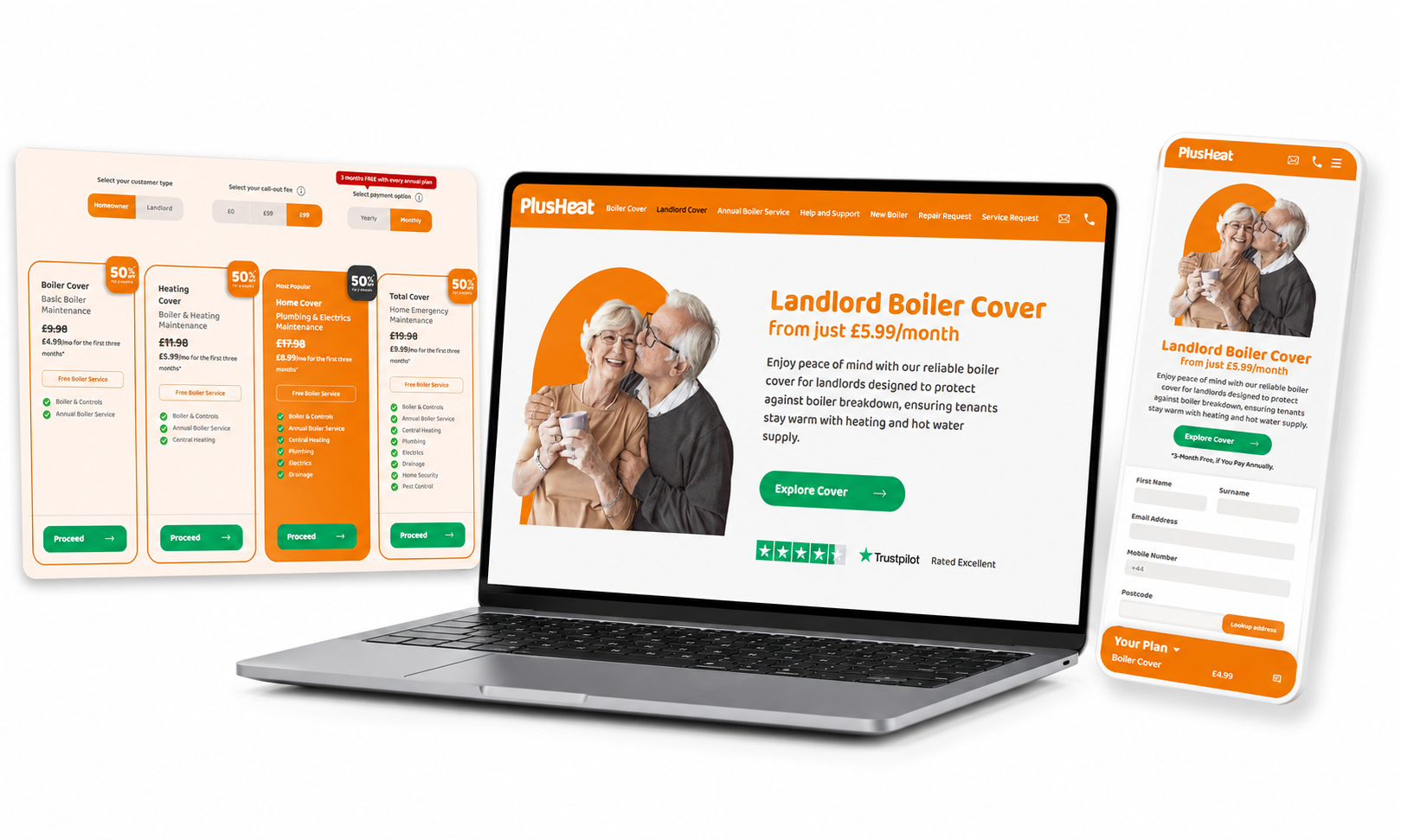
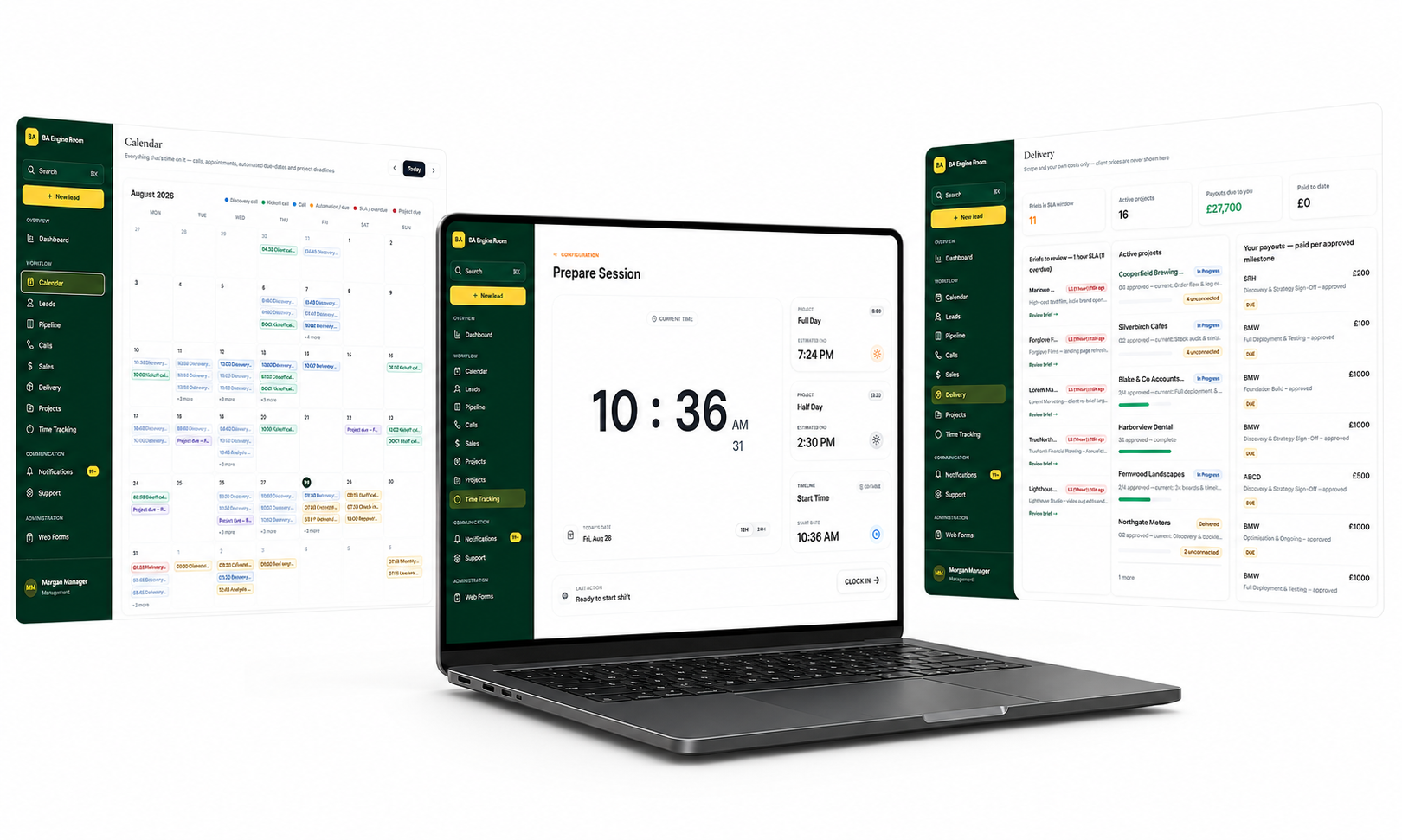
Appycodes has built and run the website conversion system for PlusHeat, a UK boiler and home-emergency cover business, since 2021. The documented production flow combines a three-axis plan configurator, postcode address lookup, a live plan summary, agreement start date, marketing preferences, CRM synchronisation and lead-source attribution. See the PlusHeat case study.
The difficult boundary is easy to miss: a valid postcode is not enough for a premises-based customer journey. The sales or operations team needs the address the customer selected, while service-area logic may need only the postcode and its geography. Collapsing both into one “address lookup” step either leaves the CRM without a complete address or makes every eligibility check depend on a paid premises lookup.
Evidence without overclaiming
The repository verifies the PlusHeat flow and Appycodes’ responsibility for it. It does not publicly record which address-data vendor is used, lookup-volume metrics or a named outage. This article therefore uses the engagement to show the verified product boundary; it does not claim that PlusHeat uses Ideal Postcodes or that a vendor caused a particular incident.
The Appycodes Premises Dependency Score
We use a simple ten-point model to stop teams buying an address service for a geography problem—or shipping a postcode API where operations need a real premises. Score the step where the address is captured, not the product as a whole.
The score is a decision aid, not an accreditation. A warehouse territory heatmap is normally 0–2. A retailer shipping parcels is usually 8–10. A home-services lead form may split: 2 for the early “do we cover your area?” step, then 9 when the customer chooses the address that operations will use. Splitting those stages is often the cleanest architecture and the best conversion experience.
A provider boundary that survives pricing and API changes
03BPremisesAddress provider
Keep provider response shapes out of your checkout, onboarding or CRM model. Return a narrow internal contract instead. That makes it possible to change provider, add a fallback, or move an API key server-side without rewriting every form.
import { NextRequest, NextResponse } from "next/server";

const compact = (value: string) =>
  value.trim().toUpperCase().split(" ").join("");

export async function GET(request: NextRequest) {
  const postcode = compact(
    request.nextUrl.searchParams.get("postcode") ?? ""
  );
  const mode = request.nextUrl.searchParams.get("mode");

  if (!/^[A-Z0-9]{5,7}$/.test(postcode)) {
    return NextResponse.json(
      { error: "Enter a full UK postcode" },
      { status: 400 }
    );
  }

  if (mode === "geography") {
    const response = await fetch(
      `https://api.postcodes.io/postcodes/${postcode}`,
      { next: { revalidate: 86400 } }
    );
    if (!response.ok) {
      return NextResponse.json({ error: "Postcode not found" }, { status: 404 });
    }
    const { result } = await response.json();
    return NextResponse.json({
      postcode: result.postcode,
      latitude: result.latitude,
      longitude: result.longitude,
      region: result.region,
      localAuthorityCode: result.codes.admin_district,
    });
  }

  if (mode === "address") {
    const key = process.env.IDEAL_POSTCODES_API_KEY;
    if (!key) throw new Error("IDEAL_POSTCODES_API_KEY is missing");
    const url = new URL(
      `https://api.ideal-postcodes.co.uk/v1/postcodes/${postcode}`
    );
    url.searchParams.set("api_key", key);
    const response = await fetch(url, { cache: "no-store" });
    if (!response.ok) {
      return NextResponse.json({ error: "Address lookup failed" }, { status: 502 });
    }
    const { result } = await response.json();
    return NextResponse.json({
      addresses: result.map((address: Record<string, string>) => ({
        line1: address.line_1,
        line2: address.line_2,
        line3: address.line_3,
        postTown: address.post_town,
        postcode: address.postcode,
        uprn: address.uprn,
      })),
    });
  }

  return NextResponse.json({ error: "Choose geography or address" }, { status: 400 });
}
The format check above is only an early guard. A regular expression cannot prove that a postcode is allocated; the provider lookup makes that decision. In production, add an abort timeout, structured error codes, request correlation, quota alerts and tests for malformed, terminated and unavailable results. Cache postcode geography aggressively enough for your freshness requirement. Cache or retain provider address data only where the contract and data licence permit it.
The failure paths belong in the user journey
| Failure | User experience | Operational control |
|---|---|---|
| Postcode malformed | Accept case and spacing variations; show a specific error | Do not spend a paid lookup |
| Valid postcode, no address returned | Offer manual address entry immediately | Record lookup outcome, not a fabricated match |
| Provider timeout or quota exhausted | Keep the form usable with manual entry | Alert on error rate and remaining balance |
| New build or converted flats missing | Let the user enter and confirm the real address | Keep provenance as “manual”; review if risk requires |
| International address | Switch to a country-aware manual/global flow | Do not force it into a UK postcode schema |
| User changes selected address | Show a review step before submission | Replace only after explicit confirmation |
GOV.UK’s address pattern recommends accepting postcodes with different case, spacing and common punctuation, and providing a manual option for international, missing or incorrectly listed addresses. It also notes that county is not required for a correct UK postal address. These are small details with outsized effects on form completion. GOV.UK Design System address pattern
Recommendations for UK retailers, SaaS teams and field-service businesses
Resolve the delivery point
Use Ideal Postcodes or an equivalent full-address service at checkout, retain manual entry, and pass the customer-confirmed address—not a postcode centroid—to fulfilment. Use Postcodes.io separately for regional analytics or service restrictions.
Do not buy precision you do not use
If the product needs region, council, constituency or approximate map placement, Postcodes.io is the simpler fit. Ask for a complete address only when the workflow genuinely acts on that premises.
Split eligibility from fulfilment
Check the postcode or service territory early. Resolve and confirm the actual property later, before a contract, appointment or CRM hand-off. This mirrors the boundary visible in the PlusHeat funnel.
Store provenance per address
Keep the selected record, source, source identifier where licensed, confirmation timestamp and manual edits. Never let a later enrichment job silently overwrite an address a buyer or seller confirmed.
What Appycodes recommends after real implementations
Begin with the output contract. If the next step needs only a postcode, coordinates or administrative code, use Postcodes.io. If a person or parcel must arrive at a door, use premises-level address data. Where the journey has both needs, keep them as separate calls with separate caching, cost and failure policies.
Whichever provider you choose, accept messy human input, offer manual entry, keep secrets and quotas controlled, store confirmation separately from enrichment, and observe the failure rate. A good address integration is not the one that always shows a dropdown; it is the one that still completes the business process when no dropdown can be shown.
Frequently asked questions
- Does Postcodes.io return a full UK address?
- No. It resolves a postcode to postcode-level geography and administrative data. It does not return the individual flats, houses or organisations that receive post at that postcode.
- Is Ideal Postcodes just a paid version of Postcodes.io?
- No. They solve different data problems. Ideal Postcodes can return structured delivery-point addresses and address search results; Postcodes.io serves open postcode and geography datasets.
- Can a retailer use Postcodes.io at checkout?
- It can validate and enrich a postcode, but it cannot populate a complete delivery address. A retailer still needs manual address entry or a delivery-address service such as Ideal Postcodes.
- Should a UK address form allow manual entry?
- Yes. Addresses can be new, missing, unusual or outside the UK. A manual path also keeps checkout and onboarding usable when the lookup provider is unavailable.
- Should an address API key be exposed in browser code?
- Only if the provider explicitly supports a browser key and it is restricted to approved origins and operations. Server-side proxying gives tighter control over secrets, quotas, logging and provider changes.
Published: 5 September 2026
Reviewed: 5 September 2026
Reviewer: Appycodes Editorial Team
This article provides technical and operational guidance, not legal or licensing advice. Confirm address data licensing, retention and regulated-product requirements for your organisation and deployment.
UK topic cluster
Company data & identity
More UK registry, identity, charity and postcode implementation guidance.
Related guide
Companies House API for onboarding
Resolve the right legal entity and keep registry data in its proper role.
Case study
PlusHeat cover-plan funnel
See the postcode-qualified lead journey and CRM hand-off in production.