

 By Ritesh Agarwal
Direct answer
A UK business can use a development team outside the UK. If a separate overseas agency or contractor can access personal data—even remotely on a UK-hosted server—that access can be a restricted transfer. The practical answer is a layered system: identify the controller, processor and sub-processors; document Article 28 terms; choose an adequacy route or appropriate safeguard such as the IDTA or Addendum where required; complete the relevant transfer risk assessment; and make synthetic data, least privilege, expiring access and audit logs part of the engineering design.
“Our database is in London” is not a complete compliance answer. Neither is “we signed an NDA”. UK GDPR separates the purpose and responsibility for processing, the rules for an international transfer, and the security of the system. A good delivery model joins all three without turning routine software work into permanent access to every customer record.
Separate the role, transfer and access questions
1. Who decides why and how the data is used?
A UK business commissioning a product will commonly be the controller for its customer or staff data. A development agency handling that data only on documented instructions will commonly act as a processor; hosting, error-tracking, support and communications vendors may be sub-processors. Labels in a proposal do not settle the role—the actual decisions and processing do.
Whenever a controller uses a processor, the relationship needs binding terms. The ICO’s Article 28 guidance lists documented instructions, confidentiality, appropriate security, sub-processor approval, help with individual rights and breach or DPIA duties, audit information, and return or deletion at the end. ICO: what a controller-processor contract must include.
2. Is personal data made accessible to a separate organisation outside the UK?
The ICO defines a transfer to include sending personal information and making it accessible to a separate organisation outside the UK. Remote production access can therefore matter even if the data never leaves a UK cloud region. The transfer is restricted when the UK GDPR applies, the transfer is initiated to an organisation outside the UK, and the receiver is a separate legal entity. ICO: what is an international transfer?
The legal-entity test changes the answer
ICO guidance distinguishes an overseas employee of the same UK legal entity from an independent contractor or agency. Access by the employee abroad does not meet the third step of the restricted-transfer test; access by a separate contractor can. Appropriate security remains necessary in either case. Map the actual companies and contracts rather than using “our team” as a legal category.
3. What can each person technically see and do?
A signed document cannot make broad production access safe. The ICO’s security outcomes call for access rights limited to people who reasonably need them, strong authentication for privileged users, controls on downloading and alteration, an audit trail, encryption and monitoring. ICO: UK GDPR security outcomes.
Treat this as an application architecture requirement. Development should normally use synthetic fixtures. Staging should use synthetic or effectively anonymised data. Production access should be exceptional, purpose-bound and narrower than the application user’s view. Pseudonymisation helps reduce harm, but the ICO notes that pseudonymised information remains personal data in the controller’s hands and for its processor. ICO: the restricted-transfer three-step test and pseudonymised data.
The compliance stack for an overseas development team
| Layer | Question | Evidence to keep | Common mistake |
|---|---|---|---|
| Data map | Which people, fields, systems and environments are involved? | Processing inventory and data-flow diagram | Listing “database” without support tools, logs, exports or backups |
| Roles | Who is controller, processor or sub-processor for each flow? | Named legal entities and responsibility matrix | Calling every supplier a processor without testing the real role |
| Article 28 | Are processor obligations binding and operational? | Signed processing terms, instructions and sub-processor register | Using only an NDA or generic confidentiality clause |
| Chapter V | Is this a restricted transfer, and what mechanism covers it? | Three-step test, adequacy check or executed safeguard | Assuming UK hosting means no transfer |
| Risk assessment | Does the safeguard keep protection not materially lower after transfer? | TRA/data-protection-test record and extra protections | Signing an IDTA and skipping the assessment |
| Security | Who can access what, from which device, for how long? | Access policy, grants, MFA evidence, logs and review results | Permanent admin accounts shared across the delivery team |
| Exit and incident | How are access, copies, breaches and deletion handled? | Offboarding log, tested response plan and deletion evidence | Removing Git access but forgetting cloud, dashboards and exports |
For a restricted transfer, the route may be UK adequacy regulations, appropriate safeguards, or a limited exception. Where appropriate safeguards are used, Article 46 options include the ICO’s International Data Transfer Agreement (IDTA) and the UK Addendum to EU Standard Contractual Clauses. The ICO says a transfer risk assessment—now called a data protection test in the legislation—must be completed, and any extra contractual, technical or organisational protections it identifies must be implemented. ICO: rules on appropriate safeguards.
The IDTA and Addendum are alternatives, not decorative annexes. The Addendum is designed to sit with the EU SCCs; the IDTA has its own tables and mandatory clauses. The ICO says the present versions should still be used while updates following the Data (Use and Access) Act are prepared during 2026. ICO: the IDTA and UK Addendum.
The real project boundary: a UK energy ERP built from India
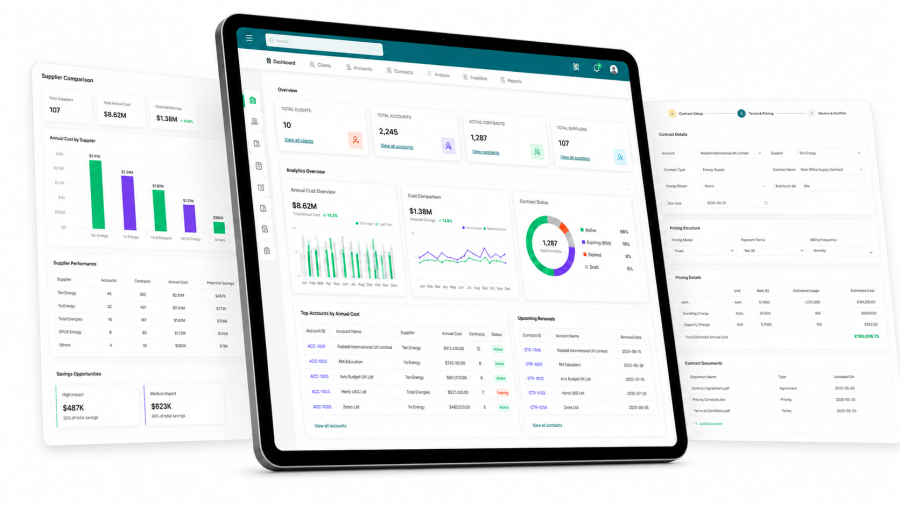
Appycodes is based in India and builds long-running systems for UK businesses. One documented example is the Professional Energy Services ERP, built and run since 2023 for a UK energy broker. The product brings clients, contacts, addresses, meter points, supplier tenders, contracts, brokerage accounting, half-hourly consumption and supplier-invoice validation into one Laravel system, with an S3 document vault and role-based access for administrators, operations representatives and partner brokers. See the Professional Energy case study.
The difficult design decision was consolidation versus exposure. Moving the operation out of spreadsheets and inboxes created a more coherent system of record, but it also concentrated records that previously sat in separate workflows. The verified response was role-aware product access: the partner broker’s needs are not the administrator’s needs. The same principle has to extend beyond application roles to development and support: a person debugging an importer rarely needs the full contact, contract and document view.
What the public evidence does and does not prove
The repository and public case study verify the system, its data domains, India-based delivery context and role-based application model. They do not expose the client’s contracts, transfer assessment, production-access logs or a security incident. We therefore use the project to show the verified access boundary and trade-off, not to claim a particular legal mechanism, breach or developer-access event.
The Appycodes Production Access Exposure Score
Our twelve-point Production Access Exposure Score (PAES) is an engineering triage model for a proposed development or support workflow. It does not decide whether a transfer is lawful; it tells the product owner how urgently to shrink the technical exposure before access is granted.
Example: a named engineer viewing status and an error code for two hours scores two or less if the record contains no identifiers and the access is logged. Give the same engineer standing database-admin access with exports and customer documents, and the score reaches seven or more. The business problem may be the same; the exposure is not.
Build a data-light delivery path and an exceptional production path
03BIncident needNamed approval and purpose
This pattern makes the lower-risk path the fastest path. Developers can reproduce validation, import and rendering failures with representative fixtures. When a production-only problem genuinely needs record access, the team requests a short-lived grant against a named client, purpose and field list. The gateway owns the query and audit event; the engineer never receives a reusable database credential.
type SupportSession = {
  engineerId: string;
  clientId: string;
  purpose: "incident" | "data-correction" | "release-check";
  approvedBy: string;
  expiresAt: Date;
  fields: Array<"accountRef" | "status" | "postcodeArea" | "errorCode">;
};

const SAFE_FIELDS = new Set([
  "accountRef", "status", "postcodeArea", "errorCode"
]);

export async function readSupportRecord(
  session: SupportSession,
  recordId: string
) {
  if (session.expiresAt <= new Date()) throw new Error("Grant expired");
  if (!session.approvedBy) throw new Error("Approval required");
  if (session.fields.some((field) => !SAFE_FIELDS.has(field))) {
    throw new Error("Field is outside the support allow-list");
  }

  // Build the query from a fixed server-side allow-list, never user input.
  const select = Object.fromEntries(
    session.fields.map((field) => [field, true])
  );

  const record = await db.customerAccount.findFirst({
    where: { id: recordId, clientId: session.clientId },
    select,
  });

  await db.productionAccessEvent.create({
    data: {
      engineerId: session.engineerId,
      clientId: session.clientId,
      recordId,
      purpose: session.purpose,
      approvedBy: session.approvedBy,
      fields: session.fields,
      grantExpiresAt: session.expiresAt,
      occurredAt: new Date(),
    },
  });

  return record;
}
In production, connect the gateway to the organisation’s identity provider, require phishing-resistant MFA for privileged roles where proportionate, send approvals to a different authorised person, prevent arbitrary query construction, encrypt transport and managed devices, and alert on unusual access or bulk reads. Logging must itself be minimised: an audit record needs who, why, what record and when—not another copy of the personal data being protected.
Failure modes that appear after the paperwork is signed
| Failure | Why it matters | Engineering response |
|---|---|---|
| Production database copied into staging | Every developer and staging integration inherits the live exposure | Generate fixtures; anonymise irreversibly only where a real distribution is needed |
| Errors include payloads | Personal data travels into logs, chat and observability sub-processors | Log stable identifiers and error classes; redact request bodies by default |
| Shared administrator login | No reliable attribution, weak offboarding and excessive privilege | Named accounts, SSO/MFA, role grants and automatic expiry |
| SQL export sent in a ticket | A controlled system becomes an uncontrolled file with new retention paths | Run a server-side diagnostic and attach a minimal, redacted result |
| Sub-processor added quietly | The controller cannot assess the new entity, location or onward transfer | Maintain a register and contractual notification/objection workflow |
| Access remains after handover | Old staff or suppliers retain a path into live data | One exit checklist across Git, cloud, database, support, VPN and vendor consoles |
A DPIA is legally required where processing is likely to result in high risk to people’s rights and freedoms, and it should influence the project rather than be a final sign-off. Even when a DPIA is not mandatory, the same discipline is useful for a new production-access path: describe the processing, assess necessity and proportionality, identify harm, and implement mitigations before launch. ICO: what is a DPIA?
Recommendations for UK SaaS, ecommerce and regulated operations
Design support access as a product feature
Give support engineers a purpose-built customer view with tenant scoping, masked fields, impersonation notices and expiry. Do not make the primary database console the support interface.
Keep payment and fulfilment data out of tickets
Use provider IDs, order states and redacted addresses for debugging. Never copy card data; minimise customer details in logs and make refunds or address changes separate privileged actions.
Split operational domains
A developer fixing an invoice parser needs the document type and extracted fields, not the full CRM relationship. Separate document, accounting, contact and contract permissions.
Assume higher impact from disclosure
Score safeguarding, beneficiary and children’s data at the top of the access model. Prefer UK-side diagnostics and synthetic records; use a DPIA and specialist review for high-risk processing.
What Appycodes recommends after cross-border implementations
Start by making routine development independent of production data. Then document the real production exceptions: incidents, corrections and release checks that cannot be resolved from telemetry or synthetic fixtures. For each exception, define the minimum fields, action, approver, duration and log. Give that technical map to the people responsible for the processing agreement and transfer mechanism so the legal description matches the system that actually runs.
Review the model when a developer, supplier, country, cloud tool or data category changes. Access control is not a one-time launch task. The useful evidence is current: named users, current sub-processors, tested revocation, reviewed logs and a support workflow that still functions without downloading the database.
Primary UK sources used for this guide
- ICO guide to international transfers
- ICO restricted-transfer three-step test
- ICO controller-processor contract requirements
- ICO appropriate-safeguards rules
- ICO IDTA and Addendum guidance
- ICO data-security outcomes
- ICO DPIA guidance
Frequently asked questions
- Can a UK company legally use developers outside the UK?
- Yes. UK GDPR does not prohibit overseas development. The UK organisation must identify the parties and data flows, put the required controller-processor terms in place, use a valid transfer mechanism where the arrangement is a restricted transfer, and apply security controls proportionate to the data and risk.
- Is remote access from abroad an international data transfer?
- It can be. ICO guidance says making personal information accessible to a separate organisation outside the UK can be a transfer, including remote access to systems. Whether it is a restricted transfer depends on the ICO's three-step test, including whether the receiver is a separate legal entity.
- Does keeping production servers in the UK avoid transfer rules?
- Not by itself. Server location and access location are different questions. A separate overseas organisation remotely accessing personal information held on UK servers can still create a restricted transfer.
- Do we need both a data processing agreement and an IDTA?
- Often, yes, but they perform different jobs. Article 28 processor terms govern processing on the controller's instructions. An IDTA, or the UK Addendum with EU SCCs, can provide an appropriate safeguard for a restricted transfer when adequacy does not cover it. A transfer risk assessment is also required when relying on appropriate safeguards.
- Can developers use pseudonymised production data instead?
- Pseudonymisation can reduce risk, but it does not automatically remove UK GDPR or transfer obligations. ICO guidance says pseudonymised information remains personal data in the controller's hands and when sent to its processor. Truly anonymous or synthetic data is the safer default for development and testing.
Published: 9 September 2026
Reviewed: 9 September 2026
Reviewer: Appycodes Editorial Team
This article provides technical and operational guidance, not legal advice. International-transfer, employment, sector-specific and contractual facts differ. Have the final arrangement reviewed by an appropriately qualified UK data-protection professional.
UK topic cluster
Engineering & compliance
UK hosting, GDPR, performance, accessibility and delivery guidance.
Related guide
Companies House API for onboarding
Apply data minimisation and preserve evidence around UK company records.
Case study
Professional Energy ERP
See the UK client, contract, invoice and document workflows behind this access model.
Service
SaaS web app development
Build secure operational software with roles, auditability and support paths.
UK delivery
Web development for UK teams
Work with Appycodes’ India-based engineering team on a controlled delivery model.
UK knowledge hub
All UK insights
Browse company data, payments, ecommerce and product-engineering clusters.