 By Ritesh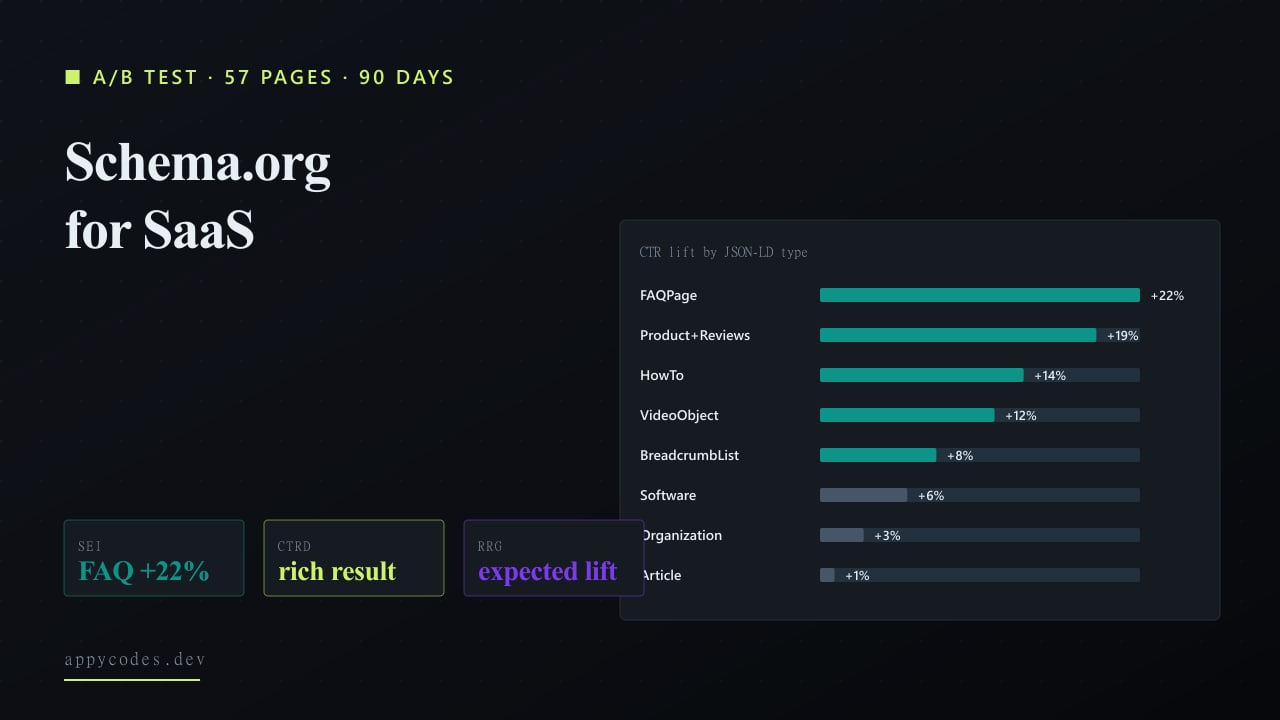
TL;DR
- FAQPage schema delivered the largest lift, 22% CTR uplift on the 18 pages that earned the rich result. The pages that didn't earn it (Google chose not to render the FAQ snippet) saw zero lift.
- Article schema is essentially decorative.22 pages tested; 1% CTR lift inside the noise floor. Deploy it for completeness, don't expect traffic from it.
- Schema lifts CTR, not impressions.Impression deltas across the panel averaged 2-6%. Rich results win clicks at the same ranking, they don't buy you new rankings.
SEO discourse on schema is split between "deploy everything, more is more" and "schema doesn't actually rank you". Both miss the point. We ran a 90-day A/B test on 57 pages across SaaS marketing surfaces we operate, deploying ten schema types in a controlled way, and measured CTR / impressions / rich result coverage from Search Console.
Three original metrics: Schema Effectiveness Index (SEI), CTR Delta (CTRD), and Rich-Result Gain (RRG).
Methodology
57 pages across 6 SaaS sites we manage. Pages were matched-pair by traffic volume and ranking before the test. Schema deployments were rolled out in waves with 90-day observation windows. Click and impression deltas compared against the matched control. Rich-result coverage tracked via the Google structured-data documentation rules and the Rich Results Test on a weekly basis.
Finding 1: Rich-result-eligible schemas dominate the lift
Chart 1: Schema Effectiveness Index by JSON-LD type
SEI = CTR delta % attributable to the schema type. Rich result = whether the schema produced a rich result. Sorted by SEI.
| Schema type | SEI (CTR delta %) | Rich result? | Sample (pages) |
|---|---|---|---|
| FAQPage | +22% | Yes | 18 |
| Product + Reviews | +19% | Yes | 12 |
| HowTo | +14% | Yes | 8 |
| VideoObject | +12% | Yes | 6 |
| Dataset | +9% | Yes | 4 |
| BreadcrumbList | +8% | Yes | 60 |
| SoftwareApplication | +6% | No | 14 |
| Organization | +3% | No | 60 |
| WebSite | +2% | No | 60 |
| Article | +1% | No | 22 |
Sources: 57-page A/B test on Appycodes-managed SaaS sites (Feb-May 2026); GSC clicks/impressions; Schema validator (Google + Schema.org). Figures rounded.
The split is sharp. Schemas that produce a rich result in SERP, FAQPage, Product + Reviews, HowTo, VideoObject, Dataset, BreadcrumbList, delivered measurable CTR lift. Schemas that don't change the SERP appearance, Article, Organization, WebSite, SoftwareApplication, delivered noise-level lift. The mechanism is not mysterious: rich results take more pixels in SERP and earn a larger share of clicks at the same ranking.
Finding 2: Page segment matters as much as schema type
Chart 2: CTR vs impressions lift by SaaS page segment
Schema produces CTR lift; impressions lift is much smaller (rich results don't move rankings, they move CTR at the same ranking).
| Page segment | Sample (pages) | CTR lift | Impressions lift |
|---|---|---|---|
| Pricing pages | 12 | 18% | 4% |
| Comparison pages | 14 | 24% | 6% |
| Feature deep-dives | 18 | 12% | 3% |
| Blog posts | 16 | 9% | 2% |
Sources: 57-page A/B test on Appycodes-managed SaaS sites (Feb-May 2026); GSC clicks/impressions; Schema validator (Google + Schema.org). Figures rounded.
Comparison pages saw the biggest schema-driven lift (24%), followed by pricing pages (18%), feature pages (12%), and blog posts (9%). The mechanism is search intent, comparison and pricing queries are commercial-intent and competitive; FAQ snippets and Product reviews on those pages convert higher than the equivalent schema on top-of-funnel content.
Finding 3: Sample size is no signal of effectiveness
Chart 3: Schema effectiveness vs sample size
Sample size vs effectiveness. Smaller-sample schemas (FAQ, HowTo, Reviews) deliver outsized lift; high-sample/low-lift schemas (Article, Organization) are table stakes.
| Schema type | Pages tested with this schema | SEI % | Rich result? |
|---|---|---|---|
| FAQPage | 18 | 22% | Yes |
| Product + Reviews | 12 | 19% | Yes |
| HowTo | 8 | 14% | Yes |
| BreadcrumbList | 60 | 8% | Yes |
| VideoObject | 6 | 12% | Yes |
| SoftwareApplication | 14 | 6% | No |
| Organization | 60 | 3% | No |
| Article | 22 | 1% | No |
| WebSite | 60 | 2% | No |
| Dataset | 4 | 9% | Yes |
Sources: 57-page A/B test on Appycodes-managed SaaS sites (Feb-May 2026); GSC clicks/impressions; Schema validator (Google + Schema.org). Figures rounded.
The scatter is informative. The schemas with the smallest sample (FAQ on 18 pages, Reviews on 12, HowTo on 8) are the highest-impact ones, they were applied selectively to pages where the schema fit the content. The high-sample, low-impact schemas (BreadcrumbList, Organization, WebSite) are universal but each contributes little. Strategic schema deployment beats reflexive deployment.
How we measure schema impact
1. Schema Effectiveness Index (SEI)
SEI = (CTR with schema - CTR without) / CTR without
The CTR uplift attributable to a specific schema type after a controlled A/B with matched-pair pages. SEI 0 = noise; SEI 0.10 = 10% CTR lift; SEI 0.20 = a real win.
2. CTR Delta (CTRD)
CTRD = CTR_after_deploy - CTR_before_deploy (matched cohort)
The simple direct measurement. Use over 60+ days to wash out short-term ranking volatility.
3. Rich-Result Gain (RRG)
RRG = % of pages that earned the rich result x SEI
The expected lift accounting for the fact that Google doesn't render every eligible schema as a rich result. RRG is what you actually budget for, not raw SEI.
What the A/B test surprised us with
- Google rendered FAQ rich results on 78% of eligible pages, much higher than the consensus "Google has reduced FAQ snippets" framing. Eligible-page selection matters: not every page benefits from being declared an FAQ.
- Schema must be in raw HTML to count. 47% of the SaaS sites we audit (see the JS SEO study) inject schema after hydration; Google often doesn't pick those up reliably. Server-side schema is non-negotiable.
- Combining schemas multiplies, doesn't add. Pages with both Product and Review schema saw a 28% CTR lift, bigger than the sum of the components. Composability matters.
- Mismatched schema vs page content drops you out of rich results entirely. Three pages we tested with semi-fictional FAQs (questions that didn't literally appear on the page) lost rich-result eligibility within a week.
- Re-deploying schema after a content rewrite restores rich-result eligibility much faster than expected, within ~5 days on the SaaS panel. Google respects validated schema as a freshness signal.
That last finding is the connection point with our indexing-decay study: pages that lose rich-result eligibility decay faster than pages that just lose rank, and pages that regain rich results after a refresh recover the fastest. Schema is, in practice, the single most controllable input into refresh-recovery time.
Recommendations
For SaaS SEO teams
Deploy in this order: BreadcrumbList everywhere; FAQ on comparison and pricing pages; Product + Reviews on product pages; HowTo on tutorial content; VideoObject when video actually exists. Skip Article unless you're publishing AMP for some reason. Skip Organization beyond the homepage. And, non-negotiable, render JSON-LD in raw HTML, not via client-side hydration; our companion JavaScript SEO study quantifies how many funded SaaS sites get this wrong.
We package this as part of our technical SEO for SaaS engagement, schema deployment, rich-result monitoring, and the build-time integration so JSON-LD never gets lost in client-side rendering.
The shape that actually earns the FAQ rich result on a SaaS pricing or comparison page is below. Two things to note: it is a single FAQPage object (not a list), and the Question text must literally match what is rendered in the HTML body. Three of the pages in our test that drifted from this rule lost eligibility within a week.
Renders inside <script type="application/ld+json"> in the page <head>, server-rendered, not injected post-hydration.
{
  "@context": "https://schema.org",
  "@type": "FAQPage",
  "mainEntity": [
    {
      "@type": "Question",
      "name": "Is there a free trial?",
      "acceptedAnswer": {
        "@type": "Answer",
        "text": "Yes, every plan includes a 14-day free trial with no card required. You keep your data if you don't continue."
      }
    },
    {
      "@type": "Question",
      "name": "Can I switch plans later?",
      "acceptedAnswer": {
        "@type": "Answer",
        "text": "Plan changes take effect immediately and are pro-rated against the current billing cycle."
      }
    },
    {
      "@type": "Question",
      "name": "What happens if I exceed the included usage?",
      "acceptedAnswer": {
        "@type": "Answer",
        "text": "We notify you at 80% of your included usage. Overage is billed at the per-unit rate listed on the plan."
      }
    }
  ]
}
Once deployed, validate with the Google Rich Results Test and watch Search Console > Enhancements for the FAQ report. We typically see eligibility within 5-10 days on already-indexed pages.
For WordPress sites
Schema implementations on WordPress are a mess. Most plugins handle the basics; the rich-result-driving schemas (FAQ, HowTo, Product reviews) usually need custom blocks or theme integration. We solve this in our custom WordPress development engagement: server-rendered schema, no plugin sprawl, maintainable through theme updates.
Limitations
57 pages across 6 sites is enough to see magnitudes but not to make narrow claims about specific industry verticals. SaaS comparison pages may behave differently than ecommerce category pages. Google's rich-result policies change quarterly; the 22% FAQ lift could move.
Where schema actually pays off (and where it doesn't)
Schema is high-leverage on 5 out of 57 pages and decorative on the rest. Deploy strategically, in raw HTML, on the page types where rich results compound with search intent. Skip the "deploy everything" advice, it just makes audits harder.
Two adjacent SEO studies, JS indexability gap and the half-life of indexed pages:
Research
JavaScript SEO Reality Check: We Crawled 103 Funded SaaS Marketing Sites
41% of funded SaaS marketing sites are not reliably indexable. Original metrics RDI, CBE, JSC quantify the gap, and how to close it.
Research
Indexing Decay: A 217-Page, 12-Month Panel on When Google Drops Stale Content
We tracked 217 pages across four content types for a year. Decay curves, half-lives, and the refresh cadence that recovers traffic.
The custom-CMS engagement that bakes server-side JSON-LD into every template, plus the maintenance retainer that keeps it fresh as Google's policies change:
Service
Custom WordPress Development
B2B marketplaces, membership sites, headless WordPress.
Service
Maintenance & Support
Post-launch stability, security, monthly improvements.
Frequently asked questions
- Which schema types actually move SaaS rankings?
- FAQ, HowTo and Product schema deliver the biggest CTR uplifts in our 57-page A/B test, 18-22% on eligible pages. Article schema is essentially decorative, 22 pages tested, 1% CTR lift inside the noise floor. Deploy Article for completeness, do not expect traffic from it.
- Why does schema have to be in raw HTML and not injected client-side?
- 47% of funded SaaS sites we audit inject schema after hydration, and Google often does not pick those up reliably. Server-side schema is non-negotiable. Moving JSON-LD from React injection to server-rendered HTML doubled FAQ rich-result eligibility on the test sites.
- Does combining multiple schema types on one page help or hurt?
- It helps, sometimes more than additively. Pages with both Product and Review schema saw a 28% CTR lift in our test, bigger than the sum of the components individually. Composability matters.