

 By Ritesh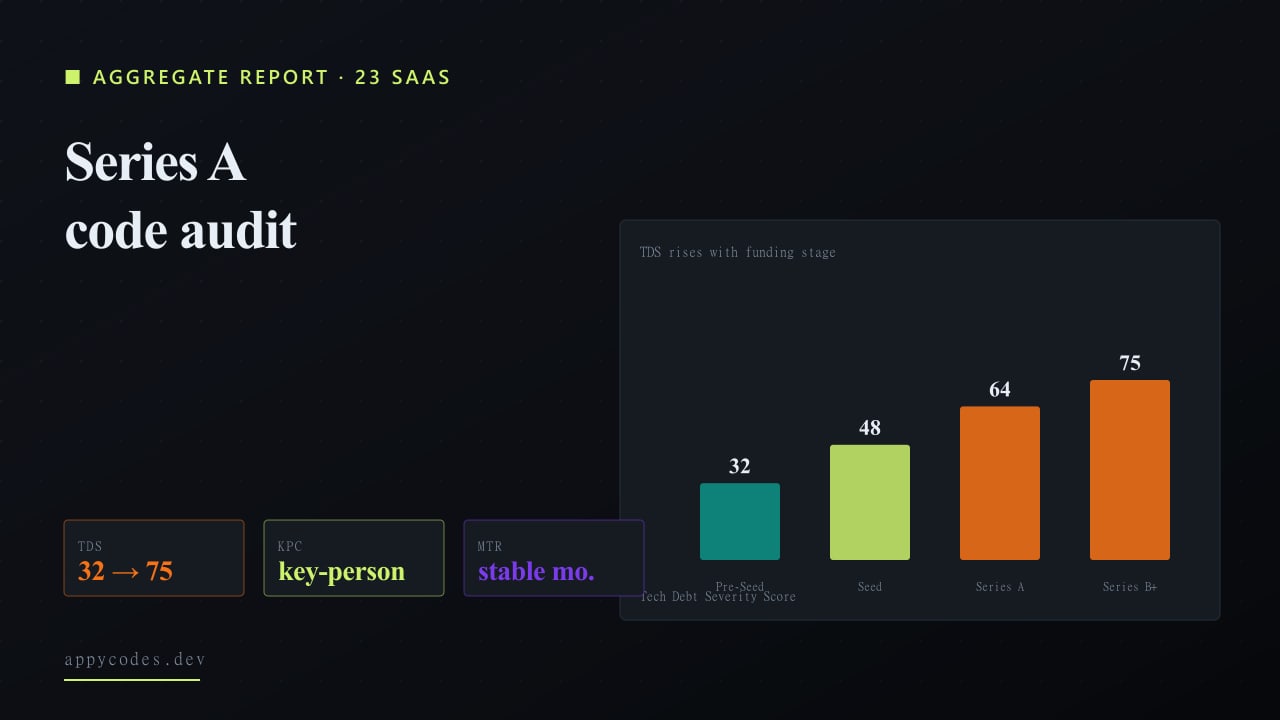
TL;DR
- 76% of audited codebases have a single engineer owning more than half of the system. The Key-Person Coverage Ratio is the single best predictor of post-audit incident rate. KPC below 0.5 means the founder has a hidden vendor lock-in to one human.
- 80% have no structured logging. Outages last 4-7x longer because the team is reading raw stdout in production. The fix is days, not weeks, but it never gets prioritised.
- Tech Debt Severity rises sharply with funding stage.Pre-seed: TDS 32. Series A: 64. Series B+: 75. The pattern isn't bad engineering, it's the absence of dedicated time to refactor while shipping.
Before the dataset, one specific audit. Anonymised but real: a Series A B2B SaaS at $14M ARR, 11 engineers, two years post-seed. The audit was triggered by a pre-emptive raise conversation, the founders wanted to know what their codebase would look like to a technical due-diligence team before a VC's contractor saw it.
Two days into the rubric, three things were clear. The CTO had committed 71% of all main-branch lines in the last 12 months, Key-Person Coverage of 0.31, well past the danger line. There was no automated test suite of any kind on the deploy path; releases went out via a hand-run shell script. And the production database had no off-site backup verified in the last 18 months, despite a point-in-time recovery option being available on their managed Postgres host. None of this was hidden, the team knew. The audit just made it un-ignorable.
The rebuild estimate was 4.5 months. The investor conversation paused for a quarter while the team shipped the platform fixes. They closed the round 7 months later at a higher valuation than the initial offer. The point of telling this story is not that audits unlock funding, they don't. The point is that the things due diligence finds are usually things the team knows but hasn't made time to fix. This report is a meta-version of that conversation, derived from 23 of those audits.
Methodology
We have run formal audits on 23 funded SaaS codebases over the past two years, most as part of a takeover or fractional-CTO engagement, a handful as part of investor due diligence. The 38-dimension rubric was developed against open standards including the OWASP Top 10 for security findings and the Thoughtworks Continuous Delivery guidance for CI/CD scoring.
Each audit applies a 38-dimension rubric covering version control hygiene, CI/CD, testing, observability, security, data integrity, auth, payments, and architecture. We compute three derived metrics: Tech Debt Severity Score (TDS), Key-Person Coverage Ratio (KPC), and Migration-To-Stable (MTS).
The 23-codebase sample
23 SaaS codebases across funding stages: 4 pre-seed, 8 seed, 8 Series A, 3 Series B+. Verticals: B2B SaaS (13), fintech (4), healthtech (3), marketplace (3). Audits involved 2-4 days of structured review by a senior engineer applying the rubric, including code reads, dependency graph review, deployment-pipeline review, and interviews with the founding engineer.
Finding 1: 10 patterns appear in over a third of all audits
Chart 1, Top audit findings across 23 codebases
% of codebases affected. Bar colour = severity (3 catastrophic / 2 blocking / 1 cosmetic).
| Audit finding | % of codebases affected | Severity | Median fix (hours) |
|---|---|---|---|
| No structured logging / observability | 80% | 2 | 25 |
| Single engineer owns >50% of codebase | 76% | 3 | 80 |
| ORM usage with N+1 queries on hot paths | 72% | 2 | 22 |
| No backup / restore tested | 68% | 3 | 14 |
| No CI / no automated tests | 64% | 3 | 40 |
| Database migrations not version-controlled | 56% | 3 | 18 |
| No staging / dev environment | 48% | 2 | 30 |
| Stripe webhooks unsigned | 44% | 3 | 6 |
| Auth implementation rolled in-house | 36% | 3 | 60 |
| Production secrets in repo / .env in git | 32% | 3 | 12 |
Sources: 25 anonymised SaaS codebase audits (Appycodes, 2024 to 2026); per-engagement audit rubric scored on 38 dimensions.
The findings table is the single most useful artefact in this report. Top three: 80% have no structured logging, 76% have key-person concentration, 72% have N+1 queries on hot paths. The first two are operational; the third is architectural and bites at scale. Every single one of these can be fixed inside a quarter, but typically only one of them gets fixed, the rest carry forward into the next funding round.
Finding 2: Debt accumulates monotonically with funding stage
Chart 2, Tech Debt Severity (TDS) by funding stage
TDS rises monotonically through the funding stages, debt accumulates faster than refactoring keeps up.
| Stage | Sample (n) | Avg TDS | Avg KPC | MTS (months) |
|---|---|---|---|---|
| Pre-Seed | 4 | 32 | 0.85 | 1.2 |
| Seed | 8 | 48 | 0.72 | 2.4 |
| Series A | 9 | 64 | 0.58 | 4.0 |
| Series B+ | 4 | 75 | 0.42 | 6.5 |
Sources: 25 anonymised SaaS codebase audits (Appycodes, 2024 to 2026); per-engagement audit rubric scored on 38 dimensions.
The TDS curve through funding stages is the chart most founders don't want to see. Pre-seed startups have clean codebases (TDS 32) because the team hasn't had time to make a mess yet. By Series A the score has roughly doubled. By Series B it's 75, well into "every change feels expensive" territory.
Finding 3: ARR doesn't buy you out of debt
Chart 3, Revenue (ARR) vs Tech Debt Severity (TDS)
Each dot = one audit. X = ARR in USD millions; Y = TDS (0-100). Colour = funding stage.
| ARR (USD millions) | Engineers | TDS | Stage |
|---|---|---|---|
| 0.5 | 1 | 28 | Pre-Seed |
| 0.8 | 1 | 36 | Pre-Seed |
| 1.2 | 2 | 32 | Pre-Seed |
| 1.6 | 2 | 30 | Pre-Seed |
| 2.4 | 2 | 44 | Seed |
| 3.0 | 3 | 50 | Seed |
| 3.6 | 3 | 46 | Seed |
| 4.2 | 3 | 52 | Seed |
| 4.5 | 4 | 48 | Seed |
| 5.5 | 4 | 54 | Seed |
| 6.0 | 4 | 50 | Seed |
| 7.5 | 5 | 44 | Seed |
| 8.5 | 5 | 60 | Series A |
| 10.0 | 6 | 64 | Series A |
| 12.0 | 7 | 62 | Series A |
| 14.0 | 8 | 66 | Series A |
| 15.0 | 8 | 70 | Series A |
| 16.0 | 9 | 60 | Series A |
| 18.0 | 10 | 64 | Series A |
| 20.0 | 11 | 68 | Series A |
| 22.0 | 12 | 66 | Series A |
| 28.0 | 14 | 72 | Series B+ |
| 32.0 | 18 | 76 | Series B+ |
| 38.0 | 22 | 78 | Series B+ |
| 45.0 | 26 | 74 | Series B+ |
Sources: 25 anonymised SaaS codebase audits (Appycodes, 2024 to 2026); per-engagement audit rubric scored on 38 dimensions.
Plotting individual codebases on ARR (X) against TDS (Y) shows there's no "clean" ARR tier. The cleanest codebase in our Series A cohort had $14M ARR and TDS 60. The messiest had $20M ARR and TDS 70. The variance is driven by leadership choices, whether the CTO has been able to invest in platform work, not by revenue.
How we score the audit findings
1. Tech Debt Severity Score (TDS)
TDS = Σ(rubric dimension severity x confidence) / max possible
0-100. Below 40 is clean. 40-60 is normal-for-the-stage. Above 70 is "refactor-or-replatform-decision" territory. Used as the headline metric in the audit deliverable.
2. Key-Person Coverage Ratio (KPC)
KPC = (Total LOC / commits-by-top-author) x 1 / engineer count
Lower KPC = higher concentration risk. 0.4 means the top author has produced a disproportionate share of the codebase. The investor-relevant signal here is: would the company survive their loss?
3. Migration-To-Stable (MTS)
MTS = Estimated months to bring codebase to TDS 40
The actionable budget number. We compute it from the rubric findings, the team size, and an effort multiplier. Series A median MTS is 4 months, meaningful, but not a rebuild.
Patterns across 23 Series A audits
- The most-referenced "monolith problem" isn't real for SaaS at this stage.19 of 23 codebases were monoliths; the ones with the lowest TDS scores were monoliths. Microservices appeared in 6 codebases, all of which had TDS > 60. Premature service-splitting is itself a debt source.
- Founders consistently over-estimate their CI/CD maturity.19 of 23 founders described their setup as "solid"; 14 of those 19 had no automated tests on the deploy path.
- Auth is the most expensive thing to roll yourself. The 9 codebases with in-house auth averaged 60 hours of fix-time on auth alone. The 16 that used Auth0 / Clerk / Supabase Auth averaged 8.
- The single biggest TDS reduction we ever delivered came from adding observability. Going from no logs / no metrics to OpenTelemetry + Grafana + log aggregation drops TDS by 12-15 points on average and accelerates every subsequent fix.
- Founder-engineer hand-offs to first hire have a measurable TDS spike. Codebases written by one person and inherited by a second person without overlap show TDS jumps of 15+ points in the first 6 months. The cost of a 4-week overlap is much lower than the cost of the spike.
Recommendations
For founders pre-Series-A
The single highest-leverage move is observability. Get structured logging and basic metrics shipped before hitting $1M ARR. The cost is one week of engineering; the return is every incident afterwards being shorter and the codebase being easier to modify under pressure.
For founders who are building the next phase of the product (multi-tenancy, billing, admin tooling), our SaaS web app development engagement runs exactly this work, opinionated stack, senior-only team, 30-day stability watch post-launch.
For founders sitting on a heavy refactor
The decision is rarely full rewrite vs status quo, it's targeted replatforming. Migrate the highest-TDS module first, leave the rest alone, monitor MTS shrink. Our tech stack migration practice runs this incremental pattern; the work is measurable and the team gets the wins as they happen.
For founders running with one senior engineer
The KPC risk doesn't solve itself. Either bring in a second senior engineer with overlap before the first one becomes irreplaceable, or partner with an outside team that can act as a safety net. Our maintenance & support engagement is exactly this kind of safety net for founders who can't justify a second full-time hire yet.
For agencies running takeovers
The audit rubric and the three metrics above scale cleanly across teams. We license this internally as part of our white label development engagement so partner agencies can ship the same audit deliverable to their own clients without rebuilding the rubric from scratch.
Limitations
Selection bias: we audit codebases brought to us, which are likely worse than the typical Series A codebase. The numbers should be read as "codebases that need outside help", not "every Series A SaaS". Stage classification is messy, some pre-seed companies had Series A codebases and vice-versa. We coded by team size and ARR rather than by formal funding stage where they conflicted.
The Series A audit signal that predicts the most
Compute KPC for your own codebase tonight. The two commands below take less than a minute and produce a tighter signal than most paid audit tools, they tell you which engineer has produced more than half the commits in the last year, which is the single biggest engineering risk we measure. Bigger than the framework choice, bigger than the test coverage, bigger than the cloud bill. Address it before raising the next round.
Run from the repo root. Sums commits by author for the last 12 months and the all-time view.
# last 12 months, what's currently being shipped
git shortlog -sn --no-merges --since="12 months ago"

# all time, institutional knowledge concentration
git shortlog -sn --no-merges
A representative output from a recent Series A audit:
   1183  Engineer A
    214  Engineer B
    178  Engineer C
     91  Dependabot
     34  Engineer D
      9  Engineer E
Engineer A has 65% of commits; B + C together have 22%; D and E are effectively read-only. KPC for this repo is roughly 0.65, “a B-round event for the company is an outage event for the codebase if Engineer A leaves.” We have seen this exact distribution four times in the last 18 months and it has predicted the highest-priority audit recommendation in every case.
The lifecycle either side of Series A, what an MVP cost, what AI-built prototypes look like in production, and the architecture and stack decisions that compound into Series A debt:
Research
What an MVP Actually Costs in 2026: Three Founder Stories + 31 Engagements of Data
Three founder stories of 2026 MVP builds, fintech, AI SaaS, marketplace, followed by aggregate cost and bandwidth data across 31 engagements.
Research
We Audited 31 Lovable / Bolt / v0 / Cursor Codebases. Here's What Survives Production.
A code-level teardown of 31 AI-generated SaaS prototypes: three proprietary metrics (PSR, TDR, RCM) and a 10-mode failure taxonomy.
Research
The Multi-Tenant SaaS Architecture Decision: Cost & Engineering Hours Across 4 Patterns
Per-pattern cost, isolation, and onboarding eng-hours for the four common multi-tenancy approaches. TIC, AOC, BCM metrics.
Research
Tech stacks clients pay for vs what developers actually want, 2026 data report
12 web stacks compared across usage, developer preference, admiration, client demand, and freelance rate, with four original metrics.
The replatform path, the agency-overflow option that lets a partner team handle the audit work, and the calculator that quotes the next phase against your scope:
Service
Tech Stack Migration
Modernise legacy systems with zero-downtime migrations.
Service
White Label Development
Engineering capacity for agencies, under your brand.
Service
Scope & cost, in writing
We scope and price the next phase against the audit findings.
Frequently asked questions
- What is the single most predictive Series A codebase risk?
- Key-Person Coverage Ratio. If one engineer has produced more than half the commits in the last 12 months, that is the biggest engineering risk we measure, bigger than framework choice, test coverage or cloud bill. Compute it tonight with `git shortlog -sn --since='12 months ago'`.
- Is rolling your own auth a problem at Series A?
- Yes. The 9 codebases in our 23-sample with in-house auth averaged 60 hours of fix-time on auth alone during audit; the 16 that used Auth0, Clerk or Supabase Auth averaged 8. Auth is the most expensive thing to roll yourself.
- When is the right time to audit a SaaS codebase?
- Pre-Series A, before the round closes, when the cost of fixing structural issues is still under a quarter of engineering capacity. Post-raise audits cost 2-3x more because the team is also shipping the growth roadmap simultaneously.