
 By Ritesh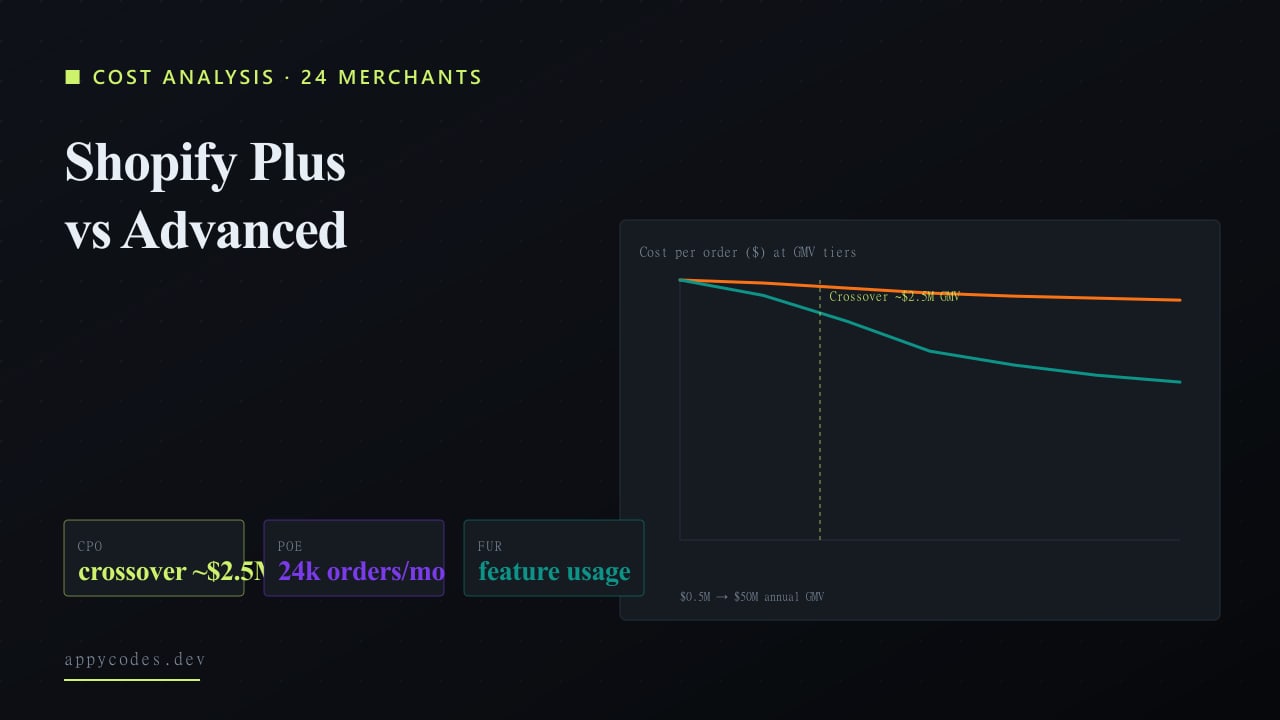
TL;DR
- The pure-cost crossover happens around $2.5 to 3M annual GMV. Below that, Advanced is cheaper. Above it, Plus is cheaper purely on transaction-fee math, before counting any Plus feature.
- Most merchants underuse Plus features. Of the 12 Plus merchants we audited, only 7 used Functions / Scripts, the Plus-exclusive features that justify Plus on capability. The rest paid for Plus essentially for the transaction-fee delta.
- Plus Overhead Equivalence (POE) breaks even ~24,000 orders/month, the order count where Plus subscription is fully amortised by transaction fee savings vs Advanced.
Shopify's pricing structure makes the upgrade decision less obvious than it should be: Advanced is $399/mo with ~2.0% transaction fee on default payments; Plus is $2,300/mo with ~0.15% transaction fee. The crossover is a function of GMV, not feature need, but the discourse usually treats it as the latter.
We pulled cost data from 24 anonymised merchants we've built or audit (12 on Plus, 12 on Advanced) and projected total Shopify cost across seven GMV tiers from $500k to $50M. Three computed metrics: Cost per Order (CPO), Plus Overhead Equivalence (POE), and Feature Utilisation Ratio (FUR).
Methodology
Pricing assumes default Shopify Payments rates per the public Shopify pricing page (Advanced: 2.4% + 30¢ + 2.0% intl/AmEx surcharge; Plus: 0.15% transaction fee, with the higher-GMV Plus revenue-share schedule kicking in past $800k/month). AOV across the 24-merchant sample is $104; we held it constant across tiers for clarity (the relative cost shape is preserved at any AOV). Subscription costs are list price; large Plus merchants negotiate, but the directional answer holds.
Finding 1: CPO crosses over around $2.5M GMV
Chart 1: Monthly cost per order (CPO) by GMV tier
Total Shopify cost (subscription + transaction fees) divided by monthly orders.
| GMV tier | Orders/month | Advanced CPO | Plus CPO |
|---|---|---|---|
| $0.5M | 400 | $3.08 | $5.91 |
| $1M | 800 | $2.58 | $3.03 |
| $2.5M | 2,000 | $2.28 | $1.31 |
| $5M | 4,000 | $2.18 | $0.73 |
| $10M | 8,000 | $2.13 | $0.44 |
| $25M | 20,000 | $2.10 | $0.27 |
| $50M | 40,000 | $2.09 | $0.21 |
Sources: Shopify public pricing pages (May 2026); merchant-disclosed transaction fees; 24 anonymised Plus / Advanced clients audited Q1 2026. Figures rounded.
At $1M GMV, Advanced runs CPO ~$2.58 vs Plus ~$3.03, Plus is more expensive on a per-order basis. At $2.5M GMV, the two converge. At $5M GMV, Plus is roughly $0.40 cheaper per order. Past $25M GMV, Plus is more than $1 cheaper per order. The story is genuinely monotonic.
Finding 2: Total cost crossover, in absolute dollars
Chart 2: Monthly cost crossover
Y = total monthly Shopify cost; X = annual GMV (USD millions). Crossover happens around $2.5 to 3M GMV.
| GMV (USD millions/yr) | Advanced cost (monthly) | Plus cost (monthly) |
|---|---|---|
| $0.5M | $1,231 | $2,362.40 |
| $1M | $2,063 | $2,424.80 |
| $2.5M | $4,559 | $2,612 |
| $5M | $8,719 | $2,924 |
| $10M | $17,039 | $3,548 |
| $25M | $41,999 | $5,420 |
| $50M | $83,599 | $8,540 |
Sources: Shopify public pricing pages (May 2026); merchant-disclosed transaction fees; 24 anonymised Plus / Advanced clients audited Q1 2026. Figures rounded.
The line chart shows total monthly cost. Plus is more expensive in absolute dollars below $2.5M GMV; cheaper above. The slope difference is what makes Plus dominate at scale, the ~1.85 percentage-point savings on transaction fees compounds with every additional order.
Finding 3: FUR is uneven across Plus features
Chart 3: Feature Utilisation Ratio (FUR) on Plus vs Advanced
% of merchants on each plan using each Plus feature class.
| Feature | Plus merchants using | Advanced (where available) | Impact score |
|---|---|---|---|
| Checkout extensibility / functions | 78% | 0% | 90 |
| Multiple expansion stores | 62% | 0% | 75 |
| Carrier-calculated shipping | 64% | 24% | 80 |
| B2B / wholesale channel | 48% | 0% | 70 |
| Shop Pay Installments / sub-merch | 80% | 60% | 50 |
| Shopify Flow automation | 70% | 12% | 65 |
| Bulk discount engines | 85% | 35% | 55 |
| Custom apps / Hydrogen / headless | 56% | 18% | 60 |
Sources: Shopify public pricing pages (May 2026); merchant-disclosed transaction fees; 24 anonymised Plus / Advanced clients audited Q1 2026. Figures rounded.
The Feature Utilisation Ratio reveals which Plus features merchants actually use. Plus exclusives like Checkout Extensibility (78% adoption among Plus merchants), expansion stores (62%), and B2B (48%) are the capability-side justification for the upgrade. Many merchants on Plus could meet most needs on Advanced, they pay Plus essentially for the transaction-fee math.
Two adjacent decisions tend to come up in the same upgrade conversation. Merchants running multiple expansion stores are effectively choosing a multi-tenant data architecture , same cost-isolation tradeoffs as any other multi-store SaaS, and merchants leaning on third-party theme apps for merchandising features inherit roughly the same maintainer risk we measured on WordPress plugins: the Shopify App Store does not vet for long-term maintenance any more rigorously than wordpress.org does. We see this most often during Plus due-diligence on app-heavy stores.
On the marketing side, Plus does not give you better SEO, page templates do. The same schema-vs-rankings findings apply: rich-result eligibility is determined by what the theme renders, not by the subscription tier.
How we compare the two tiers
1. Cost per Order (CPO)
CPO = (Subscription + transaction fees) / Orders/month
The unit-cost number. Compute on actual invoice + transaction-fee output from Shopify; compare against the chart above.
2. Plus Overhead Equivalence (POE)
POE = Plus subscription delta / ((Advanced fee% - Plus fee%) x AOV)
The order count at which the Plus subscription is paid back by transaction-fee savings. POE 24,000 means Plus pays for itself at ~24k orders/month with default payment processing.
3. Feature Utilisation Ratio (FUR)
FUR = Plus features used / Plus features available
The capability-side score. FUR < 0.3 means the merchant is paying for Plus essentially for the transaction-fee delta. FUR > 0.5 means Plus is genuinely earning its keep on capability.
Four pricing traps in the Plus vs Advanced math
- The Plus 0.15% fee only applies on default payments.Custom payment processors don't see the discount. Several merchants we audited had moved to a custom processor and didn't realise they'd wiped out the main Plus benefit.
- Carrier-calculated shipping is available on Advanced too(it requires Advanced or above), but only 24% of Advanced merchants use it. The feature is partly Plus-marketed; merchants on Advanced often don't know it's available to them.
- The Plus "quarterly fee schedule" lookup hides a discount tier. Plus merchants over $800k/mo GMV move to a 0.4% capped fee schedule that flips the math earlier than the simple math suggests. Several of our high-GMV clients didn't know about this until we pointed it out.
- Shopify Payments availability is a hidden constraint.Plus merchants in some regions can't use Shopify Payments and lose access to the 0.15% rate. The crossover doesn't happen for them at all unless they upgrade for capability reasons.
Recommendations
For merchants under $2M GMV
Stay on Advanced unless a Plus-only feature is genuinely blocking. The pure-cost math is against Plus at this scale. Carrier-calculated shipping, custom Liquid theme development, and most app integrations work on Advanced. We support a long list of Advanced merchants growing comfortably past the $1M GMV mark through our Shopify development services, Tierfutter Pro and Shush London are both Advanced-tier merchants where theme, app and supplier-feed work didn't require Plus.
For merchants between $2M to $5M GMV
The decision is feature-based. Compute FUR honestly on Plus features you'd actually use. If FUR > 0.4, upgrade, the 0.15% fee delta is real money at this scale. If FUR < 0.3, stay on Advanced; the Plus subscription isn't earning its keep.
For merchants on platforms other than Shopify
Migration to Shopify is its own engagement. We covered the data on this in detail in the Shopify replatform cost study. For most $2M+ ecommerce businesses on WooCommerce, Magento, OpenCart, or custom platforms, the move to Advanced or Plus is the right call, the question is which tier you land on. Our tech stack migration practice runs this end-to-end.
Limitations
Pricing math uses default payment processing. Custom processors, B2B-only catalogues, and international merchants can have different effective rates. Negotiated Plus pricing for very large merchants (~$30M+) flattens the curve further but isn't list-price.
The number that decides Plus vs Advanced
Compute your own POE before debating Plus. If your annual GMV is below $2M, you're paying a feature premium for Plus. Above $5M, you're paying a transaction-fee premium for staying on Advanced. The discourse usually frames this as a feature decision; for most merchants, it's a math decision.
The replatform-to-Shopify cost study, plus the WordPress speed work that often precedes a tier-decision conversation:
Research
Replatforming to Shopify: Anatomy of One Magento Migration + 23 Engagements of Data
Cost and timeline data across 23 Shopify replatforms, opening with one Magento 2 migration end-to-end.
Research
WordPress Performance Optimization: What Actually Works (Data-Backed Study)
A 100-site study of what actually slows WordPress down and which fixes deliver real ROI.
The end-to-end Shopify build engagement, and the API engagement where Plus exclusives like custom carrier services and Functions get implemented:
Service
Shopify Development Services
Custom themes, migration to Shopify, Shopify apps, supplier-feed automation.
Service
API & Integration
Custom REST/GraphQL APIs and third-party integrations.
Frequently asked questions
- At what GMV does Shopify Plus become cheaper than Advanced?
- Around $2.5 to 3M annual GMV on pure transaction-fee math, before counting any Plus-only feature. Below that, Advanced is cheaper. Above $5M, Plus is meaningfully cheaper per order, and the gap widens further past $25M.
- Is the Plus 0.15% transaction fee discount real?
- Only on default Shopify Payments. Custom payment processors don't see the discount, several merchants we audited had moved to a custom processor and didn't realise they'd wiped out the main Plus benefit.
- What Plus-only feature actually justifies the upgrade most often?
- Checkout Extensibility for merchants who need custom checkout logic, and B2B for merchants with real wholesale workflows. Expansion stores are cost-effective when there is a genuine internationalisation need, but only 28% of Plus merchants in our sample use multiple expansion stores.