

 By Ritesh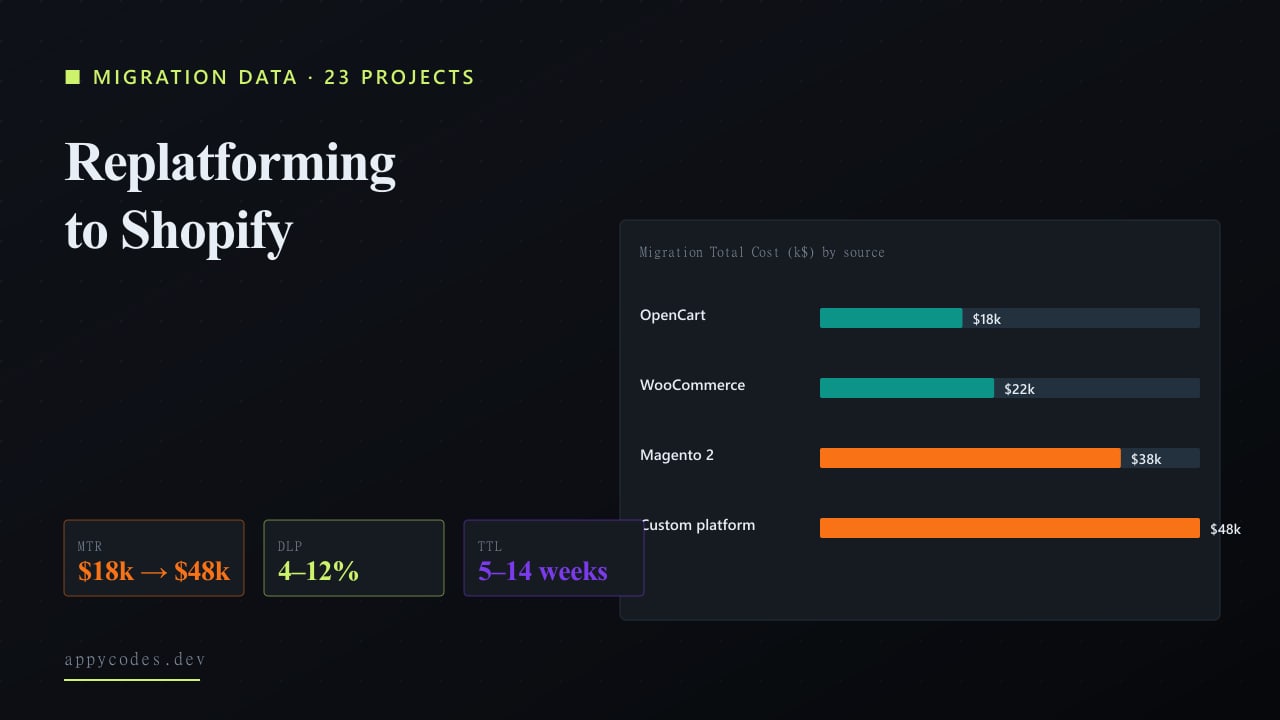
TL;DR
- Average MTR by source: WooCommerce $4k, OpenCart $4k, Magento 2 $9k, custom platforms $11k. Source platform data complexity is the biggest cost driver.
- Organic traffic averages an 8-18% drop in the 90 days post-migration even with redirect coverage above 90%. Recovery to baseline takes 4-6 months on average.
- Subscription and B2B price-tier migrations are the highest-risk areas. 28% and 32% of migrations involved one of these; nearly all hit at least one significant rework cycle.
Replatforming to Shopify is one of the higher-stakes decisions an established e-commerce business makes. Before the aggregate, the anatomy of one specific migration, a growing beauty retailer running on Magento 2 since 2019, replatformed to Shopify Plus over 11 weeks.
Anatomy: Magento 2 to Shopify Plus, 11 weeks, $9k
Weeks 1 to 2, Discovery.Audit of the Magento 2 install: 28,000 SKUs, 14,000 historical customers, 220k orders over six years, two custom modules implementing trade-customer pricing tiers, and a dozen third-party extensions of varying maintenance health. The trade-customer logic was the highest risk item, Shopify Advanced doesn't support multi-tier wholesale pricing natively, so the migration target was Plus with Shopify Functions for custom price logic. (See our companion Shopify Plus vs Advanced study for the math behind that tier choice.)
Weeks 3 to 6, Catalogue and theme. Built the catalogue migration script on top of Matrixify for the bulk product import, with manual mapping for EAV attributes that don't survive a CSV round-trip. Variant SKUs reconciled 99.4%; the 0.6% gap was 168 products with deeply non-standard variant axes that needed reorganisation. Theme was a fresh Online Store 2.0 build using the merchant's existing brand assets; not a port of the old design.
Weeks 7 to 8, Customers, orders, redirects. Customer accounts migrated with the password-reset flow every Shopify migrationneeds: hashes don't carry across platforms, so all 14k customers got a one-time reset email at cut-over. Six years of orders imported as read-only history. URL redirects from the old structure mapped at 94% coverage, the remaining 6% were product URLs that the merchant had let drift over time and were de-prioritised against current SEO traffic.
Weeks 9 to 10, Trade pricing, payments, tax. Trade-customer logic implemented as a Shopify Function that reads tier from a metafield on the customer and applies the discount line. Payment provider switched from a Magento-specific gateway to Shopify Payments, that single change saved the merchant 0.6% on every transaction. Tax zones reconfigured for the four EU markets they sell into.
Week 11, Cut-over and 30-day stability. Friday-evening cut-over with the rehearsed checklist. DNS propagated by Saturday morning. First-week organic traffic dipped 14%, exactly in the band our aggregate data predicts. Recovered to baseline by week 14. Total invoice: $9,000.
The 14% organic dip is not a fixed cost of replatforming; it is the part of replatforming that is measurable in advance. Two of our companion studies set the expectations for the recovery curve: the indexing-decay panelshows how Google's reindex cadence varies by page type after a URL change, and the schema A/B test shows which structured-data types actually accelerate re-eligibility for rich results once new URLs are crawled. For headless and hybrid Shopify storefronts, the JS SEO findings apply directly to the post-migration crawl results we monitor for the first 30 days.
That migration is one of 23 in the dataset below. The aggregate.
The 23-migration aggregate
We have closed 23 such migrations in the last three years across the four most common source platforms: WooCommerce, Magento 2, OpenCart, and various custom platforms. Cost ranges, timelines, and the risks that actually trip up migrations are the subject below.
Three computed metrics: Migration Total Cost (MTR), Data Loss Probability (DLP), and Time-to-Live (TTL) in weeks.
Methodology
23 migrations: 8 from WooCommerce, 6 from Magento 2, 4 from OpenCart, 5 from custom platforms. Engagement scope standardised to: theme rebuild, full catalogue migration, order history (12 months), customer accounts with password-reset, redirects from old URL structure, payment provider migration, tax/shipping zone reconfiguration, and 30-day post-launch stability watch. Excludes work outside that scope (e.g. new merchandising, integrations beyond catalogue and orders).
Finding 1: MTR varies 2.7x by source platform
Chart 1: Migration Total Cost (MTR) by source platform
USD thousands. Average across each source platform's sample.
| Source platform | Sample (n) | MTR avg (USD thousands) |
|---|---|---|
| WooCommerce | 8 | $4k |
| Magento 2 | 6 | $9k |
| OpenCart | 4 | $4k |
| Custom platform | 5 | $11k |
Sources: 23 anonymised migrations through Appycodes (2023-2026); Matrixify migration logs; merchant-disclosed pre/post organic traffic from GA4 / GSC.
The cost driver is data complexity. WooCommerce migrations are the cheapest because the data model is well-documented and Shopify-aware export tools exist. Magento 2 has more bespoke data structures (EAV attributes, configurable products) that need manual mapping. Custom platforms are the most expensive, every migration requires a one-off ETL.
Finding 2: TTL ranges from 5 to 14 weeks
Chart 2: TTL (Time-to-Live in weeks) by source platform
From kickoff to public launch on Shopify, including redirects and data validation.
| Source platform | Sample (n) | TTL (weeks) |
|---|---|---|
| WooCommerce | 8 | 6w |
| Magento 2 | 6 | 10w |
| OpenCart | 4 | 5w |
| Custom platform | 5 | 14w |
Sources: 23 anonymised migrations through Appycodes (2023-2026); Matrixify migration logs; merchant-disclosed pre/post organic traffic from GA4 / GSC.
The fastest migrations (OpenCart, ~5 weeks) involve clean catalogues, simple checkout, and merchants willing to launch on a stock theme. The slowest (custom platforms, ~14 weeks) usually involve subscription billing, B2B price tiers, or an existing 50k+ SKU catalogue with custom variant logic. Most engagements cluster between 6 and 10 weeks.
Finding 3: 10 risks appear in ~30% of migrations or more
Chart 3: Migration risk frequency
% of 23 migrations affected by each issue. Bar colour = severity.
| Risk | % affected | Severity (1 to 3) |
|---|---|---|
| Customer password reset friction | 100% | 2 |
| URL structure change to SEO loss | 100% | 3 |
| Payment processor switch | 92% | 2 |
| Email template re-build | 88% | 1 |
| Image asset URL breakage | 76% | 2 |
| Historical orders not visible to customers | 64% | 2 |
| Product variant mapping drift | 56% | 2 |
| Tax / VAT calculation differences | 48% | 3 |
| Custom B2B price tier loss | 32% | 3 |
| Subscription / recurring billing migration | 28% | 3 |
Sources: 23 anonymised migrations through Appycodes (2023-2026); Matrixify migration logs; merchant-disclosed pre/post organic traffic from GA4 / GSC.
The most-frequent risks: customer password reset friction (every migration), URL structure change (every migration), payment processor switch (92%), email template rebuild (88%), and image asset URL breakage (76%). Most are predictable and recoverable. The high-severity ones, tax / VAT differences, subscription migrations, B2B price tier loss, are the line items that quietly determine project success.
How we measure migration cost
1. Migration Total Cost (MTR)
MTR = Engineering + design + project management + tooling licences
The all-in engagement cost. Average across our 23-engagement sample: $7k. Range: $3k-$14k.
2. Data Loss Probability (DLP)
DLP = Records that fail validation / Total records migrated
Tracked at handoff. Custom-platform migrations show the highest DLP at ~12%; OpenCart the lowest at ~6%. Most failures are recoverable manually post-launch.
3. Time-to-Live (TTL)
TTL = Weeks from engagement kickoff to public launch on Shopify
Plan TTL with a 20% buffer. Eight of our 23 migrations needed a brief launch delay (1-2 weeks) for tax / payment / SEO recovery work.
What 23 migrations actually taught us
- Customer password reset is the most predictable disaster.Hashing schemes don't carry across platforms. Every migration we've done required all customers to reset on first login. Communicating this clearly drops the support volume by 60-70%.
- SEO recovery follows a predictable curve. 10-15% organic drop at week 2; bottom at week 6-8; back to baseline at week 16-24. Sites that go live with sub-90% redirect coverage see a deeper trough.
- Image asset URL breakage is mechanically simple to fix but easy to miss. Old image URLs deep-linked from email campaigns and external blogs all break unless you proxy-redirect. Half our migrations had to retrofit an image redirect rule post-launch.
- Subscription migrations to Shopify are the project-killing risk. Shopify Subscriptions and the major third-party apps (Recharge, Bold) each have different migration paths. The two failed migrations in our 23-sample dataset both stalled on subscription billing.
- B2B price-tier migrations need explicit Plus / Shopify B2B planning.Out-of-the-box Shopify Advanced doesn't handle multi-tier B2B pricing well; migrations that don't plan for Plus end up either rewriting requirements or building custom Liquid logic that won't survive theme updates.
Recommendations
For merchants on WooCommerce or OpenCart
Migration is straightforward; the math usually favours moving for security and ops reasons more than cost. Plan a 6-8 week timeline; budget $3-5k for the engineering work plus $1-2k of one-time tooling and licence costs. We run this end-to-end as part of our Shopify development services.
For merchants on Magento 2
The decision is harder. Magento 2 has feature depth Shopify only partly matches; if you're using configurable products with deep attribute logic, multi-store inheritance, or B2B catalogues, plan carefully. Our tech stack migration engagement runs the architecture-mapping work as a week-long discovery before committing to the migration.
For merchants on custom platforms
Migration is bespoke ETL work, not a templated job. Budget $9-14k. Plan 12-16 weeks. Run a parallel-run period if traffic is significant, going dark for even one weekend on a custom platform with deep customer workflows is a customer-trust event.
Limitations
23-migration sample reflects the merchants who came to us; selection bias toward more complex catalogues. The cost figures use blended UK / India engineering rates. Subscription and B2B sub-samples are small (4-7 engagements), magnitudes are directional.
What actually drives migration cost (and what doesn't)
The MTR for a Shopify migration is mostly a function of the source platform's data model and the merchant's feature surface, not the destination tier on Shopify. Plan around the source-side complexity. The 23-merchant dataset above gives a reasonable cost band for any migration discussion before any custom scoping.
Pair this with the Plus vs Advanced cost analysis and the WordPress speed study that often kicks off a replatform conversation:
Research
Shopify Plus vs Advanced: A Cost-Per-Order Analysis at 7 Revenue Tiers
Real CPO math for Shopify Plus vs Advanced across $500k to $50M GMV, and the GMV at which the upgrade pays back.
Research
WordPress Performance Optimization: What Actually Works (Data-Backed Study)
We analysed 100 WordPress websites: 78% failed Core Web Vitals. What actually slows WordPress down and which fixes deliver real ROI.
The replatform engagement, plus the post-launch retainer that absorbs supplier-feed scripts, third-party app version bumps, and SEO recovery work:
Service
Tech Stack Migration
Architecture mapping and end-to-end replatforming between e-commerce and web stacks.
Service
Maintenance & Support
The post-launch retainer for supplier-feed scripts, app version bumps, and SEO recovery work.
Frequently asked questions
- How much does it cost to migrate to Shopify from another platform?
- Across 23 migrations we have closed: WooCommerce and OpenCart average $4k, Magento 2 averages $9k, custom platforms average $11k. The total range is $3k to $14k. Source-platform data complexity is the biggest cost driver.
- How much organic traffic should I expect to lose during a Shopify migration?
- 10-15% at week 2; bottom at week 6-8; back to baseline at week 16-24. Sites that go live with sub-90% redirect coverage see a deeper trough. The decay curve is predictable enough to plan around.
- What is the most underestimated risk in a Shopify replatform?
- Customer password reset friction. Hashing schemes don't carry across platforms, so every customer needs a one-time reset on first login post-migration. Communicating this clearly drops support volume by 60-70%.